How to identify a yellow perch
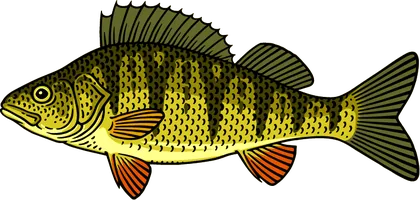
Golden-yellow to brassy-green flanks with six to eight dark vertical bars running down the sides, two separate dorsal fins, and bright orange pelvic and anal fins in adults. Nothing else in fresh water carries that combination of yellow body and bold tiger striping.
Walleye and sauger share the two-dorsal percid body plan but are much larger, olive-grey, and lack the bars.
| Scientific name | Perca flavescens |
|---|---|
| Family | Perches (Percidae) |
| Also known as | ringed perch, lake perch, jack perch |
| Water type | Freshwater |
| Body type (app weight estimate) | Panfish |
Where yellow perch are found
Native across the northern and eastern US and most of Canada, and introduced widely in the West. Especially abundant in the Great Lakes, the upper Midwest, New England, the Chesapeake tributaries, and across Ontario, Quebec and the prairie provinces.
Commonly targeted in: Connecticut, Delaware, Iowa, Idaho, Illinois, Indiana, Kansas, Kentucky, Massachusetts, Maryland, Maine, Michigan, Minnesota, Missouri, Montana, North Carolina, North Dakota, Nebraska, New Hampshire, New Jersey, New York, Ohio, Oregon, Pennsylvania, Rhode Island, South Carolina, South Dakota, Utah, Virginia, Vermont, Washington, Wisconsin, West Virginia, Wyoming, Colorado, Nevada, New Mexico, Arizona, Alberta, British Columbia, Manitoba, New Brunswick, Newfoundland and Labrador, Nova Scotia, Northwest Territories, Ontario, Prince Edward Island, Quebec, Saskatchewan, Yukon.
Why this matters on a leaderboard. A yellow perch from one end of that range and one from the other are not competing on equal footing — climate, forage and growing season all shift what a good fish looks like. That is why Fish Masters Live runs both nationwide weekly boards and custom tournaments you can lock to a state, a region, or a single body of water.
Habitat and where to look
Perch are school fish that relate to bottom in relatively shallow to mid-depth water.
- Weed edges and weed flats — the summer standard, especially in 8–20 feet.
- Sand and gravel flats — perch feed heavily on insect larvae, small crayfish and minnows on clean bottom.
- Deep basin structure — in winter and late summer, humps and flats in 20–45 feet.
- The Great Lakes — perch relate to rock and sand in 20–60 feet and move seasonally in enormous schools.
Because schools are size-segregated, a spot producing five-inch perch will keep producing five-inch perch. Move.
Yellow Perch season by season
Spring
Perch spawn early, right after ice-out, in shallow water — often the first fish in the lake to spawn, at roughly 45–52 °F. They deposit long gelatinous ribbons of eggs over vegetation and brush.
Pre-spawn and post-spawn fish are shallow and easy to reach from shore. Many jurisdictions close or limit perch during the spawn; check the local rules.
Summer
Weed edges and flats. Small jigs, live minnows and worm harnesses fished near bottom. Perch feed all day, unlike most species, which makes them a good midday option.
Larger perch pull deeper as water warms and can be found on humps and deep flats.
Fall
The best perch fishing of the year in most of the range. Fish group heavily and feed aggressively as water cools, and the average size climbs.
Great Lakes fall perch runs are a major regional fishery — Lake Erie in particular draws serious crowds in October and November.
Winter
A cornerstone ice-fishing species across the North. Perch roam the basin in large schools, which makes hole-hopping and mobility the winning strategy.
Small jigging spoons tipped with a minnow head, and tungsten jigs with waxworms or plastics, are the standard.
Techniques and baits that work
| Technique | When and why it works |
|---|---|
| Small jig tipped with live bait | A 1/16–1/8 oz jig with a minnow head, waxworm or piece of crawler, fished on or near the bottom. The universal perch presentation. |
| Live minnow on a bottom rig | A simple two-hook spreader or drop rig with small shiners. The Great Lakes standard. |
| Jigging spoon | A 1/8–1/4 oz spoon tipped with bait, both through ice and open water. The aggressive-search option. |
| Worm harness / crawler rig | Slow-trolled along weed edges and flats. Effective for covering water in summer. |
| Drop-shot | For finicky deep-water perch on the Great Lakes and big reservoirs. |
Go-to baits: Live shiners · Minnow heads · Waxworms · Nightcrawler pieces · 1/16 oz chartreuse jig
How to measure a yellow perch accurately
Perch are small — a 12-inch perch is a good fish and a 14-inch perch is a genuine trophy anywhere — so measurement precision matters proportionally more.
Two species-specific notes: their dorsal spines are sharp and their gill covers are edged with a spine, so handle from the side rather than gripping over the top of the head. And their tail is only slightly forked, so squaring it changes the number less than on most species, but do it anyway for consistency.
Perch lie flat easily and are among the simplest species to measure cleanly.
In the app: lay the fish flat, point your camera at it, and Fish Masters Live measures the length from the image and proposes the species automatically. You can drag the measurement box before you confirm, and every submission is reviewable — which is what makes a leaderboard built on photos actually trustworthy.
Handling and release
Perch are hardy fish and release well in cool water. Two things to watch:
- Deep hooking. Perch inhale bait and small hooks go deep. Set on the first tap and use a #6 or smaller.
- Barotrauma from deep Great Lakes water. Fish taken from 50+ feet often cannot return. If you are catching them deep, plan to keep your limit.
Perch are also one of the few species where selective harvest genuinely helps: perch populations frequently stunt from overabundance, and many northern lakes benefit from anglers keeping a limit of mid-size fish.
Common questions about yellow perch fishing
What is a big yellow perch?
Twelve inches is a good fish anywhere. Thirteen to fourteen inches is a genuine trophy, and those fish come mostly from Lake Erie, the Chesapeake tributaries, large Canadian lakes and a handful of managed inland waters.
What is the best bait for yellow perch?
Live minnows or minnow heads on a small jig, fished right on the bottom. Perch feed heavily on small fish and insect larvae, and no artificial consistently outfishes live bait for them.
Why do perch schools all seem to be the same size?
Perch school by year class and size, which is a predator-avoidance behavior. It means a spot producing small fish will keep producing small fish — the fix is not to change baits but to move, sometimes only a couple hundred yards.
When do yellow perch spawn?
Right after ice-out, at roughly 45 to 52 °F, making them one of the earliest-spawning freshwater gamefish. They lay long gelatinous egg ribbons over vegetation and submerged brush in shallow water.
Check your regulations. Seasons, size limits, slot limits and bag limits for yellow perch vary by state, province and often by individual water body, and they change. Always confirm the current rules with your state or provincial fish and wildlife agency before you fish.