How to identify a bluegill
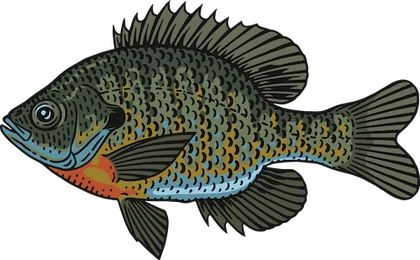
Deep, laterally compressed, and dark olive with faint vertical bars. Two marks identify a bluegill: a solid black flap on the rear of the gill cover with no colored margin, and a dark blotch at the rear base of the soft dorsal fin. Breeding males go coppery-orange on the breast with a purple-blue sheen on the cheek and gill cover.
Compare to a pumpkinseed, whose gill flap has a bright red or orange crescent on the edge, and a redear, whose flap edge is red and whose flanks are speckled rather than barred.
| Scientific name | Lepomis macrochirus |
|---|---|
| Family | Sunfish family (Centrarchidae) |
| Also known as | bream, brim, copperbelly, sunny |
| Water type | Freshwater |
| Body type (app weight estimate) | Panfish |
Where bluegill are found
Native to the eastern and central United States and introduced essentially everywhere else. Present in all 48 contiguous states, Hawaii, and southern Canada from Ontario through the prairie provinces and into British Columbia.
Commonly targeted in: Alabama, Arkansas, Arizona, California, Colorado, Connecticut, Delaware, Florida, Georgia, Hawaii, Iowa, Idaho, Illinois, Indiana, Kansas, Kentucky, Louisiana, Massachusetts, Maryland, Maine, Michigan, Minnesota, Missouri, Mississippi, Montana, North Carolina, North Dakota, Nebraska, New Hampshire, New Jersey, New Mexico, Nevada, New York, Ohio, Oklahoma, Oregon, Pennsylvania, Rhode Island, South Carolina, South Dakota, Tennessee, Texas, Utah, Virginia, Vermont, Washington, Wisconsin, West Virginia, Wyoming, Ontario, Quebec, Manitoba, Saskatchewan, British Columbia, New Brunswick.
Why this matters on a leaderboard. A bluegill from one end of that range and one from the other are not competing on equal footing — climate, forage and growing season all shift what a good fish looks like. That is why Fish Masters Live runs both nationwide weekly boards and custom tournaments you can lock to a state, a region, or a single body of water.
Habitat and where to look
Anywhere with warm water and cover.
- Spring — shallow flats with hard bottom, in colonies of dish-shaped beds you can often see from shore.
- Summer — weed edges, dock shade, brush piles, and — for the biggest fish — the deep weedline in 8–16 feet, well away from the crowds.
- Winter — basin edges and deep weeds. Under ice, suspended over the basin.
The key insight most anglers miss: big bluegill and small bluegill do not live in the same place. If you are catching four-inch fish steadily, move deeper and away from the obvious bank.
Bluegill season by season
Spring
The spawn is the most productive and most visible bluegill window of the year. As water reaches roughly 67–75 °F, males fan colonies of beds in 1–4 feet on sand and gravel, often dozens of beds packed together.
Bluegill spawn repeatedly through summer, so the pattern recurs — but the first wave holds the largest fish.
Summer
Post-spawn, the biggest bluegill retreat to deep weed edges and stay there. This is the least-fished and most productive summer pattern: a small jig or a piece of crawler fished on the outside weedline in 10–15 feet.
Shallow-water panfishing stays easy but the average size drops sharply.
Fall
Bluegill feed hard as water cools and move somewhat shallower again. September and October produce excellent numbers and good size, with far less pressure than spring.
Winter
A premier ice-fishing species across the North. Bluegill suspend over basins and along deep weed edges and are caught on tungsten jigs tipped with waxworms or plastics.
Big winter bluegill are notoriously finicky — small baits, light line, and a sensitive spring bobber make the difference.
Techniques and baits that work
| Technique | When and why it works |
|---|---|
| Small jig under a float | A 1/32–1/80 oz jig with a plastic or a live grub, suspended at a fixed depth. The most versatile panfish rig there is. |
| Live bait on a small hook | A piece of nightcrawler, a cricket or a red worm on a #8–#10 hook. Nothing catches more bluegill. |
| Fly rod poppers | A small foam popper or a sponge spider in spring and summer. Bluegill on a 3-weight is one of the best fights per ounce in fishing. |
| Drop-shot for big fish | Underrated. A tiny drop-shot on the deep weedline is how you catch nine- and ten-inch bluegill in summer. |
| Tungsten ice jig | 1/32–1/16 oz tungsten with a plastic tail, fished slowly with a spring bobber. |
Go-to baits: Red worm · Cricket · Waxworm · 1/32 oz chartreuse jig · Small foam spider
How to measure a bluegill accurately
Bluegill are small, which means every fraction of an inch is a bigger share of the total — a 9.0" and a 9.4" fish are meaningfully different on a leaderboard.
Lay the fish flat with its dorsal fin relaxed. If the dorsal is locked upright, gently fold it down; a raised dorsal does not change length but does confuse automatic detection.
Their tail is slightly forked. Square it. Keep the mouth closed — bluegill mouths are small so the error is small, but consistency is what makes a leaderboard fair.
Handle the dorsal spines with care. They are sharp and they will get you.
In the app: lay the fish flat, point your camera at it, and Fish Masters Live measures the length from the image and proposes the species automatically. You can drag the measurement box before you confirm, and every submission is reviewable — which is what makes a leaderboard built on photos actually trustworthy.
Handling and release
Bluegill are hardy, but they are also the species most often deep-hooked because of their small mouths and the way they inhale bait.
- Use small hooks and set quickly. A #10 hook set on the first tap rarely goes deep.
- Where legal, circle hooks nearly eliminate gut-hooking.
- If a fish is deeply hooked, cut the line at the mouth rather than digging. Survival is far higher.
- Wet your hand. Bluegill lose slime easily.
One conservation note: many small lakes and ponds are stunted precisely because too many large bluegill get kept. Releasing the biggest fish and keeping the medium ones is what actually improves a pond.
Common questions about bluegill fishing
What is the difference between a bluegill and a sunfish?
Bluegill are one species of sunfish. "Sunfish" is the family — Lepomis — which also includes pumpkinseed, redear, green sunfish, longear and warmouth. A bluegill is identified by its solid black gill flap with no colored edge and the dark blotch at the rear of the soft dorsal.
What is a big bluegill?
Nine inches is a genuinely good fish anywhere. Ten inches is a trophy in most of the country. A pound-plus bluegill — usually 10 to 11 inches — is a fish most anglers never catch, and they come from the deep weedline, not the bank.
What is the best bait for bluegill?
A red worm or a cricket on a small hook under a float. For larger fish specifically, a 1/32 oz jig with a small soft plastic fished on the deep weedline outperforms live bait because it filters out the small ones.
When do bluegill spawn?
When water reaches roughly 67 to 75 °F — May in the mid-latitudes, as early as March in Florida, June in the far North. They spawn in repeated waves through summer, with the first wave holding the biggest fish.
Bluegill guides by region and season
Check your regulations. Seasons, size limits, slot limits and bag limits for bluegill vary by state, province and often by individual water body, and they change. Always confirm the current rules with your state or provincial fish and wildlife agency before you fish.