How to identify a brown trout
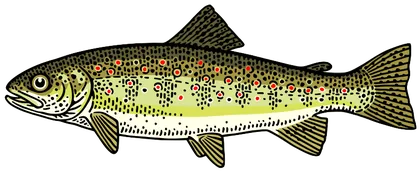
Butter-yellow to olive-brown flanks with black and rust-red spots, many of them surrounded by pale halos, and a tail that is largely or entirely unspotted. That combination — red halo spots plus a clean tail — separates browns from rainbows at a glance.
Large males develop a hooked lower jaw (a kype) in fall. Lake-run and sea-run browns go silver and lose most of their color, which makes them easy to confuse with steelhead; check the tail, which stays unspotted.
| Scientific name | Salmo trutta |
|---|---|
| Family | Salmonids (Salmonidae) |
| Also known as | brownie, German brown, loch leven |
| Water type | Freshwater |
| Body type (app weight estimate) | Skinny |
Where brown trout are found
Introduced from Europe in 1883 and now established across the northern US, the Appalachians, the Rockies, the Great Lakes and much of Canada. Browns tolerate warmer and dirtier water than brook trout and have replaced them in many eastern streams.
Commonly targeted in: Arkansas, Arizona, California, Colorado, Connecticut, Georgia, Iowa, Idaho, Illinois, Indiana, Kentucky, Massachusetts, Maryland, Maine, Michigan, Minnesota, Missouri, Montana, North Carolina, North Dakota, Nebraska, New Hampshire, New Jersey, New Mexico, Nevada, New York, Ohio, Oklahoma, Oregon, Pennsylvania, Rhode Island, South Carolina, South Dakota, Tennessee, Utah, Virginia, Vermont, Washington, Wisconsin, West Virginia, Wyoming, Alabama, Alberta, British Columbia, Manitoba, New Brunswick, Newfoundland and Labrador, Nova Scotia, Ontario, Prince Edward Island, Quebec, Saskatchewan.
Why this matters on a leaderboard. A brown trout from one end of that range and one from the other are not competing on equal footing — climate, forage and growing season all shift what a good fish looks like. That is why Fish Masters Live runs both nationwide weekly boards and custom tournaments you can lock to a state, a region, or a single body of water.
Habitat and where to look
Browns want cover, current break, and shade. They are more structure-oriented than rainbows and consistently take the best lie in a pool.
- Undercut banks, root wads, log jams, boulder pockets.
- The deepest, darkest part of a pool, especially the head where food funnels in.
- Bridge shadows and any overhead cover in daylight.
They handle water into the low 70s better than rainbows and brook trout, which is why browns dominate the lower ends of many trout streams while brookies hold the headwaters.
Brown Trout season by season
Spring
Post-spawn fish recovering and feeding. Hatches build through April and May — blue-winged olives, caddis, march browns — and browns will feed on the surface far more readily in spring than in high summer.
High water from snowmelt or rain makes big browns catchable in daylight: they move to the soft edges and eat streamers.
Summer
Daylight fishing gets hard. Big browns go nocturnal. Serious brown trout anglers fish the last hour of light and the first two hours of dark, swinging large streamers and mouse patterns.
Terrestrial fishing — hoppers along grassy banks — is the best daytime option from July through September. Fish the shade line tight to the bank, not the middle of the river.
Fall
The best brown trout season, without argument. Browns spawn in autumn, become aggressive and territorial, and lose some of their caution. Streamer fishing peaks from late September into November.
Great Lakes tributaries fill with lake-run browns. Respect actively spawning fish on redds — do not fish over them, and watch where you wade.
Winter
Tailwaters and spring creeks fish well with small midges and nymphs. In freestone rivers browns hold in slow deep water and eat sparingly, but a well-drifted nymph or a slowly stripped streamer will still take fish on a mild afternoon.
Techniques and baits that work
| Technique | When and why it works |
|---|---|
| Streamer fishing | The big-brown method. Large articulated streamers stripped fast or swung on a sink tip. Best in low light, high water and fall. |
| Nymphing | Deep dead drifts through the heads of pools and along undercut banks. The workhorse method for numbers. |
| Night fishing | Mouse patterns and large wet flies after dark in summer. This is how most genuine trophy browns are caught in small water. |
| Terrestrials | Hopper, ant and beetle patterns tight to grassy banks, July through September. |
| Jerkbait / minnow plug | In lakes and larger rivers, a suspending minnow plug fished slowly imitates the small fish adult browns live on. |
Go-to baits: Articulated streamer · Sculpin pattern · Hopper patterns · Brown woolly bugger · Suspending minnow plug
How to measure a brown trout accurately
A large brown trout is worth measuring correctly and worth measuring fast.
Keep the fish in the net in the water while you set up. Lay it out, jaw closed, on a wet surface, tail extended but not stretched. The tail is nearly square, so total length and fork length are close — but square the lobes anyway for consistency.
Fall browns in spawning condition are heavy and soft. Support the fish under the pectoral fins and the vent; do not let the belly hang unsupported, which can rupture internal tissue in a gravid female.
In the app: lay the fish flat, point your camera at it, and Fish Masters Live measures the length from the image and proposes the species automatically. You can drag the measurement box before you confirm, and every submission is reviewable — which is what makes a leaderboard built on photos actually trustworthy.
Handling and release
Everything in the rainbow trout handling notes applies, plus two brown-specific points:
Do not fish for browns on redds. In October and November, actively spawning browns are visible, vulnerable and easy to catch. Catching them is legal in many places and is still a bad idea — you are removing the next generation for a photo.
Big browns take longer to revive. A 24-inch brown after a hard fight needs real time facing into current before it can hold itself upright. Hold it there until it kicks free on its own.
Common questions about brown trout fishing
Why are brown trout so hard to catch?
They are the most predator-wary salmonid in North America, they feed heavily at night, and adults switch to eating other fish rather than insects — so they eat less often and are less likely to be fooled by a drifting fly. Fishing low light, high water and larger baits is how you tilt the odds.
What is the best time of year for big brown trout?
October and November. Browns spawn in the fall, become aggressive and territorial, and lose some caution. It is also when lake-run browns push into tributaries around the Great Lakes.
Are brown trout native to North America?
No. They were brought from Europe starting in 1883. Their tolerance for warmer, siltier water let them colonize streams that native brook trout had already been pushed out of by logging and agriculture.
What is the difference between a brown trout and a brook trout?
Brook trout are char: dark green with pale worm-like vermiculation on the back, red spots with blue halos, and white leading edges on the lower fins. Brown trout are yellow-brown with black and red spots and no white fin edges.
Check your regulations. Seasons, size limits, slot limits and bag limits for brown trout vary by state, province and often by individual water body, and they change. Always confirm the current rules with your state or provincial fish and wildlife agency before you fish.