How to identify a brook trout
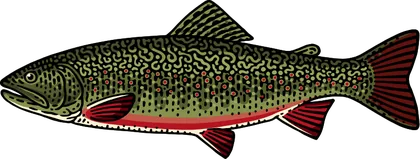
Dark olive-green back covered in pale, worm-like squiggles called vermiculation — a marking no other trout has. Flanks carry scattered red spots, each ringed with a blue halo. The lower fins have brilliant white leading edges backed by a black stripe. The tail is nearly square, which is where "squaretail" comes from.
Spawning males in October turn deep orange on the belly with black flanks. It is one of the genuine spectacles of North American freshwater fishing.
| Scientific name | Salvelinus fontinalis |
|---|---|
| Family | Salmonids (Salmonidae) — char |
| Also known as | brookie, speckled trout, squaretail |
| Water type | Freshwater |
| Body type (app weight estimate) | Skinny |
Where brook trout are found
Native to eastern North America from Georgia's southern Appalachians to Labrador and west to the Great Lakes and Hudson Bay. Introduced into the Rockies and the West. Wild native populations survive mostly in cold, high-elevation headwaters and in the Canadian Maritimes and Quebec.
Commonly targeted in: Connecticut, Georgia, Iowa, Massachusetts, Maryland, Maine, Michigan, Minnesota, North Carolina, New Hampshire, New Jersey, New York, Ohio, Pennsylvania, Rhode Island, South Carolina, Tennessee, Virginia, Vermont, Wisconsin, West Virginia, Colorado, Idaho, Montana, New Mexico, Nevada, Oregon, Utah, Washington, Wyoming, California, South Dakota, Newfoundland and Labrador, Nova Scotia, New Brunswick, Prince Edward Island, Quebec, Ontario, Manitoba, Saskatchewan, Alberta, British Columbia, Yukon, Northwest Territories, Nunavut.
Why this matters on a leaderboard. A brook trout from one end of that range and one from the other are not competing on equal footing — climate, forage and growing season all shift what a good fish looks like. That is why Fish Masters Live runs both nationwide weekly boards and custom tournaments you can lock to a state, a region, or a single body of water.
Habitat and where to look
The coldest and cleanest water in the system. Brook trout need water under about 65 °F and cannot tolerate warm summers, silt, or low oxygen.
- Headwater streams — small, steep, shaded, often only a few feet wide. Plunge pools and undercut banks.
- Beaver ponds and spring seeps — cold refuge in an otherwise marginal stream.
- Northern lakes — in Maine, Quebec, Labrador and the Maritimes, brookies live in lakes and grow far larger than stream fish.
- Coasters and salters — Lake Superior and coastal New England populations that use big water.
Where brown trout and rainbows have been introduced, brook trout are usually pushed to the very top of the drainage. That upper limit is where you find them.
Brook Trout season by season
Spring
Small streams come alive as soon as the water clears from runoff. Brookies are opportunistic and aggressive after a long winter, and a small spinner or a bushy dry fly will catch fish that have not seen an angler since October.
This is the easiest brook trout fishing of the year and the best time to introduce someone to it.
Summer
Cold water is everything. Fish the shaded upper reaches, spring seeps and plunge pools. A small stream that runs 68 °F at the bridge may run 58 °F a mile above it — walk.
Terrestrials work extremely well: brook trout in small water eat ants, beetles and inchworms all summer and are not selective about pattern, only about presentation.
Fall
Spawning season, roughly September through November. Males are at their most spectacular and most aggressive.
Many jurisdictions close small wild-trout streams in the fall precisely because spawning brookies are so easy to catch. Check the regulations for the specific stream, not just the state — brook trout rules are often water-by-water.
Winter
Most small-stream brook trout water is closed or frozen. In the North, brook trout are a prime ice-fishing target on lakes and ponds, taken on small jigs and live minnows in shallow water — often under 10 feet, which surprises people.
Techniques and baits that work
| Technique | When and why it works |
|---|---|
| Small dry fly | An Elk Hair Caddis, Adams or Royal Wulff in size 12–16. Wild brookies in small water are among the most willing dry-fly fish anywhere. |
| Micro spinner | A 1/16 oz inline spinner cast upstream into plunge pools. Deadly and easy. |
| Short-line nymphing | Tight-line a small bead-head through pocket water. Nine feet of line and a lot of walking. |
| Live worm on a small hook | Where legal, still the most effective way to catch brook trout in tight cover. |
| Small jig under a float | Ice fishing and pond fishing. Tip with a waxworm or minnow head. |
Go-to baits: Small worm · Elk Hair Caddis · Gold micro spinner · Beadhead pheasant tail · Waxworm
How to measure a brook trout accurately
Brook trout are small — a 10-inch wild stream brookie is a good fish, and a 14-inch one is exceptional. That makes measurement precision matter proportionally more than it does on a 20-inch bass.
Use a wet surface every time and keep the fish low to the ground so a flop is not a fall. Their squared tail means fork and total length are nearly identical, but square it anyway.
Because brookies are so small and so easily injured, the fastest honest workflow is: net, keep in water, set the mat, one lift, one frame, back in. Under ten seconds.
In the app: lay the fish flat, point your camera at it, and Fish Masters Live measures the length from the image and proposes the species automatically. You can drag the measurement box before you confirm, and every submission is reviewable — which is what makes a leaderboard built on photos actually trustworthy.
Handling and release
Brook trout are the most fragile fish in the species list. In small headwater streams you are often fishing an isolated population where every adult matters.
- Barbless hooks, always.
- Never fish for them when the stream is above about 65 °F.
- Do not set them on dry rock, moss or your shirt.
- Land them fast. A five-minute fight on a 9-inch fish is a dead fish.
If you are fishing native brook trout water, treat every fish as if the population depends on it — in a lot of headwaters, it does.
Common questions about brook trout fishing
Is a brook trout a trout?
Technically no. Brook trout are char, in the genus Salvelinus alongside lake trout, Arctic char and Dolly Varden. Char have light spots on a dark body; true trout have dark spots on a light body.
How big do brook trout get?
In small streams, 6 to 10 inches is typical and 14 inches is a trophy. In the large lakes of Maine, Quebec, Labrador and Manitoba, brook trout reach 20 inches and beyond. Habitat, not genetics, sets the ceiling.
Where can I catch native brook trout?
Cold headwater streams in the Appalachians from north Georgia to Maine, throughout New England and New York, and across eastern Canada. In the West, brook trout are present everywhere but introduced. Look for the highest-elevation, most shaded water in a drainage.
Why are brook trout disappearing from eastern streams?
Warming water, sedimentation from development and agriculture, loss of streamside shade, acid deposition, and competition from introduced brown and rainbow trout. They are a cold-clean-water indicator species — their range map is essentially a map of intact headwaters.
Check your regulations. Seasons, size limits, slot limits and bag limits for brook trout vary by state, province and often by individual water body, and they change. Always confirm the current rules with your state or provincial fish and wildlife agency before you fish.