How to identify a arctic char
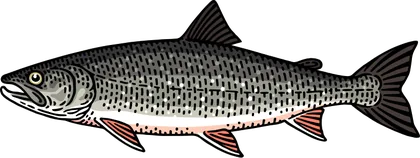
Silver to blue-grey in the sea; brilliant orange to blood-red on the belly and flanks in spawning condition. Pale pink to cream spots on a darker body — light spots, char signature — with no black spots anywhere, which separates them from any trout.
The tail is only shallowly forked, less than a lake trout's. The lower fins carry white leading edges like a brook trout's, but char lack the brook trout's back vermiculation.
Landlocked char in Maine and New Hampshire — sometimes called blueback trout or Sunapee trout — are smaller, slimmer and much less colorful than sea-run northern fish.
| Scientific name | Salvelinus alpinus |
|---|---|
| Family | Salmonids (Salmonidae) — char |
| Also known as | char, iqaluk, alpine char |
| Water type | Freshwater and saltwater |
| Body type (app weight estimate) | Skinny |
Where arctic char are found
The northernmost freshwater fish on earth. In North America: Alaska, northern Quebec (Nunavik), Labrador, Nunavut, the Northwest Territories and Yukon, plus isolated relict populations in deep cold lakes in Maine and New Hampshire.
Commonly targeted in: Alaska, Maine, New Hampshire, Nunavut, Northwest Territories, Yukon, Quebec, Newfoundland and Labrador, Manitoba.
Why this matters on a leaderboard. A arctic char from one end of that range and one from the other are not competing on equal footing — climate, forage and growing season all shift what a good fish looks like. That is why Fish Masters Live runs both nationwide weekly boards and custom tournaments you can lock to a state, a region, or a single body of water.
Habitat and where to look
Cold. Arctic char live in water that would kill most gamefish.
- Sea-run populations — spend the short Arctic summer feeding in coastal bays and estuaries, then run back into river systems in late summer to overwinter in lakes. They cannot survive winter in salt water.
- River mouths and estuaries — the highest-percentage water in July and August, as fish stage before running up.
- Lake systems — deep, cold, low-productivity northern lakes, where landlocked populations live year-round.
Access is the limiting factor for nearly every angler: most of the range is fly-in only.
Arctic Char season by season
Spring
Ice is still on most of the range. Where open water exists, char are in the lakes and can be taken through the ice or in leads.
In Nunavik and Nunavut this is subsistence-fishing season more than sport season.
Summer
The season. Sea-run char are in coastal waters through July and begin staging at river mouths from late July into August. This is when nearly all sport fishing for char happens.
Fish are chrome-bright, feeding aggressively on capelin and sand lance, and will hit spoons, streamers and small plugs hard.
Fall
Late August and September are the peak on many northern rivers as char run up in numbers and begin coloring. Bright orange fish against tundra is the image the entire fishery is built on.
Water is dropping, fish are concentrated in pools, and the fishing can be extraordinary. It is also very short — freeze-up follows quickly.
Winter
Char overwinter under ice in lake systems. Inuit communities across the Arctic fish for them through the ice as an important food source. Sport fishing is essentially nonexistent at this time of year.
Techniques and baits that work
| Technique | When and why it works |
|---|---|
| Casting spoons | A 1/2–3/4 oz silver, pink or orange spoon. The most reliable char lure there is, and the standard on northern rivers. |
| Streamer fly fishing | 8–9 weight rods with baitfish and shrimp patterns in pink, orange and chartreuse. Char eat flies eagerly. |
| Small plugs | Minnow-profile plugs worked through pools and river mouths. |
| Jigging through ice | Spoons and jigs on overwintering lake fish — mainly a subsistence method. |
Go-to baits: Pink spoon · Silver casting spoon · Orange streamer · Shrimp pattern fly
How to measure a arctic char accurately
Sea-run char are heavy-bodied and thick through the shoulders, and are almost always landed in remote conditions with cold hands and no flat surface.
Bring a mat. Tundra gravel, rock and moss all strip slime and damage fish, and there is rarely a boat deck. A rolled-up wet mat weighs nothing and is the single most useful piece of gear on a fly-in trip.
Their tail is shallowly forked; square the lobes lightly. Support the belly — spawning-condition fish are soft.
In the app: lay the fish flat, point your camera at it, and Fish Masters Live measures the length from the image and proposes the species automatically. You can drag the measurement box before you confirm, and every submission is reviewable — which is what makes a leaderboard built on photos actually trustworthy.
Handling and release
Arctic char populations are small, slow-growing and heavily relied on for subsistence by Inuit and First Nations communities across their range. That context matters more here than for any other species in the app.
- Follow local and territorial regulations exactly, and respect community-managed waters.
- Cold air can freeze gill tissue in seconds in September. Minimize air exposure — it is not just about stress, it is literally about frostbite.
- Release fish in moving water and hold them until they swim off.
Common questions about arctic char fishing
Where can you catch Arctic char in North America?
Alaska, Nunavut, the Northwest Territories, Yukon, northern Quebec (Nunavik) and Labrador, plus small relict landlocked populations in a handful of deep, cold lakes in Maine and New Hampshire. Nearly all of the range is fly-in.
When is Arctic char season?
Late July through September, when sea-run fish stage at river mouths and then run upstream. The window is short — freeze-up ends it abruptly.
What is the difference between Arctic char and lake trout?
Both are char. Arctic char have pink or cream spots, often a brilliant orange or red belly, and a shallow tail fork. Lake trout are grey with cream spots and a deeply forked tail. They overlap across much of the Arctic.
Are Arctic char and salmon the same?
No, though they are both salmonids and both anadromous. Char are in the genus Salvelinus with lake trout and brook trout; Pacific salmon are Oncorhynchus and Atlantic salmon are Salmo. Unlike Pacific salmon, char survive spawning and return year after year.
Check your regulations. Seasons, size limits, slot limits and bag limits for arctic char vary by state, province and often by individual water body, and they change. Always confirm the current rules with your state or provincial fish and wildlife agency before you fish.