How to identify a arctic grayling
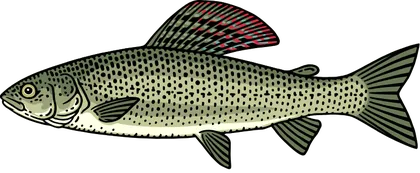
Nothing else looks like a grayling. The dorsal fin is huge — a sail two or three times taller than any other freshwater fish's, marked with rows of iridescent spots and edged in orange or violet. The body is silver-grey to purple-bronze with a scattering of small black spots on the forward flank and an iridescent sheen that shifts blue and lavender in the light.
The mouth is small and the eye large — a drift-feeding insectivore's build.
| Scientific name | Thymallus arcticus |
|---|---|
| Family | Salmonids (Salmonidae) |
| Also known as | grayling, sailfish of the north |
| Water type | Freshwater |
| Body type (app weight estimate) | Skinny |
Where arctic grayling are found
Alaska, Yukon, the Northwest Territories, Nunavut, northern British Columbia, Alberta, Saskatchewan and Manitoba, plus a native relict population in the upper Missouri drainage in Montana and stocked populations in Montana, Wyoming and Utah high lakes.
Commonly targeted in: Alaska, Montana, Wyoming, Utah, Yukon, Northwest Territories, Nunavut, British Columbia, Alberta, Saskatchewan, Manitoba, Ontario.
Why this matters on a leaderboard. A arctic grayling from one end of that range and one from the other are not competing on equal footing — climate, forage and growing season all shift what a good fish looks like. That is why Fish Masters Live runs both nationwide weekly boards and custom tournaments you can lock to a state, a region, or a single body of water.
Habitat and where to look
Cold, clear, moving northern water.
- Rivers and streams — the classic habitat. Grayling hold in runs and pools, often stacked by size, with the largest fish at the head of the pool where food arrives first.
- Tundra lakes — abundant in northern lakes, cruising shallow shorelines and inlet mouths.
- Inlets and outlets — where a stream enters or leaves a lake concentrates both food and grayling.
They need cold, clean water and disappear quickly where habitat degrades — which is why the native Montana population is now confined to a fraction of its historical range.
Arctic Grayling season by season
Spring
Grayling spawn shortly after ice-out in shallow gravel, without building redds. Fish are concentrated in tributaries and stream mouths.
In Alaska and the Yukon this is May and June, and the fishing turns on almost the moment the ice leaves.
Summer
The main season. Grayling in northern rivers feed on the surface constantly through the long daylight of June, July and August, and are unfussy about pattern.
They stratify by size in a pool: small fish in the tail, larger fish at the head. Work the head of a run first if you want a big one.
Fall
Fish drop back downstream toward wintering areas as water cools through September. Fishing stays good but the window closes fast.
Late-season grayling put on weight and are at their heaviest of the year.
Winter
Grayling overwinter in deep river pools and lake basins under ice. They are occasionally taken through the ice but are not a significant winter sport target.
Techniques and baits that work
| Technique | When and why it works |
|---|---|
| Dry fly | An Adams, Elk Hair Caddis or Parachute in size 14–18. Grayling are among the most willing dry-fly fish anywhere; presentation matters far more than pattern. |
| Small nymph | A beadhead pheasant tail or hare's ear drifted through runs takes the larger fish that hold deeper. |
| Micro spinner | A 1/16 oz inline spinner in gold or silver. Effective on lake fish and in fast water. |
| Small jig under a float | Lake-shore and inlet fishing, especially for people who do not fly fish. |
Go-to baits: Parachute Adams · Elk Hair Caddis · Beadhead hare's ear · Small gold spinner
How to measure a arctic grayling accurately
Grayling are small and delicate — a 14-inch fish is very good, an 18-inch fish is exceptional — so precision matters and speed matters more.
Their enormous dorsal fin is the one species-specific hazard: do not lay the fish on the fin or fold it. Set the fish on its side with the dorsal free, and the fin will lie naturally.
Wet everything. Grayling scales come off easily and their skin is thin.
In the app: lay the fish flat, point your camera at it, and Fish Masters Live measures the length from the image and proposes the species automatically. You can drag the measurement box before you confirm, and every submission is reviewable — which is what makes a leaderboard built on photos actually trustworthy.
Handling and release
Grayling are fragile and are frequently caught in numbers, which multiplies the effect of sloppy handling across a day.
- Barbless hooks. On a fifty-fish day, barbless is the difference between a fun day and a lot of dead fish.
- Keep them in the water. Use a net, unhook in the net, and lift only for the frame.
- The Montana native population is a conservation priority and is managed accordingly — check the specific regulations for that drainage.
Common questions about arctic grayling fishing
Where can you catch Arctic grayling in the lower 48?
Montana holds the only native lower-48 population, in the upper Big Hole River drainage and a few connected waters, where they are a conservation priority. Stocked grayling also exist in high-elevation lakes in Montana, Wyoming and Utah.
Are Arctic grayling easy to catch?
Where they are abundant, yes — they are among the most willing dry-fly fish in North America. Presentation matters more than pattern. Larger grayling are more selective and hold in the fastest, most food-rich water at the head of a pool.
How big do Arctic grayling get?
Most fish run 10 to 14 inches. An 18-inch grayling is a genuine trophy anywhere, and the largest fish in the world come from remote Arctic river systems in Alaska, Yukon and the Northwest Territories.
What is the big fin on a grayling for?
The oversized dorsal is primarily a display structure used in spawning — males flare it over females and in territorial contests. It also gives grayling a distinctive rolling fight.
Arctic Grayling guides by region and season
Check your regulations. Seasons, size limits, slot limits and bag limits for arctic grayling vary by state, province and often by individual water body, and they change. Always confirm the current rules with your state or provincial fish and wildlife agency before you fish.