How to identify a northern pike
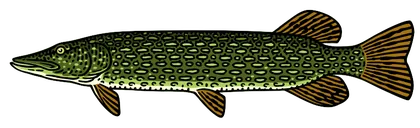
Long, cylindrical, olive-green body covered in irregular rows of light bean-shaped spots on a darker background — light on dark, the opposite of a muskie. The dorsal fin sits far back near the tail. Duck-bill snout full of teeth.
The definitive separation from muskellunge is the cheek and gill cover: a pike's cheek is fully scaled and the lower half of the gill cover is bare. On a muskie, only the upper half of both is scaled. Also count submandibular pores under the jaw: pike have five or fewer per side, muskies six or more.
| Scientific name | Esox lucius |
|---|---|
| Family | Pikes (Esocidae) |
| Also known as | pike, northern, jack, snake, water wolf |
| Water type | Freshwater |
| Body type (app weight estimate) | Skinny |
Where northern pike are found
Circumpolar. In North America: from Alaska across all of Canada, through the Great Lakes and New England, down the upper Mississippi drainage, with introduced populations in the Rockies, the Southwest and parts of the mid-Atlantic.
Commonly targeted in: Alaska, Colorado, Connecticut, Iowa, Idaho, Illinois, Indiana, Kansas, Massachusetts, Maryland, Maine, Michigan, Minnesota, Missouri, Montana, North Dakota, Nebraska, New Hampshire, New Jersey, New Mexico, Nevada, New York, Ohio, Oregon, Pennsylvania, Rhode Island, South Dakota, Utah, Vermont, Washington, Wisconsin, West Virginia, Wyoming, Arizona, Virginia, Alberta, British Columbia, Manitoba, New Brunswick, Northwest Territories, Nunavut, Ontario, Quebec, Saskatchewan, Yukon, Newfoundland and Labrador.
Why this matters on a leaderboard. A northern pike from one end of that range and one from the other are not competing on equal footing — climate, forage and growing season all shift what a good fish looks like. That is why Fish Masters Live runs both nationwide weekly boards and custom tournaments you can lock to a state, a region, or a single body of water.
Habitat and where to look
Weeds and ambush points, in cool water.
- Shallow weed flats and bays — especially in spring and early summer. Pike sit motionless in cabbage and coontail waiting.
- Weed edges and points — the deep edge of a weed flat is the single most reliable pike structure in a lake.
- River backwaters and slow current — pike hold in slack water beside current.
- Deep basins in summer — in clear lakes with a thermocline, the largest pike go deep and cool, often 20–40 feet, chasing ciscoes.
Big pike and small pike separate in summer. If you are catching hammer handles in the weeds all day, the big ones are somewhere cooler.
Northern Pike season by season
Spring
Pike spawn immediately after ice-out in shallow flooded marsh and bay vegetation, at roughly 40–52 °F — the earliest-spawning major gamefish in the North.
Post-spawn, they linger in the shallow warm bays for weeks and are extremely catchable. Spring is the easiest pike fishing of the year and produces plenty of large fish. Many jurisdictions have closed seasons during the spawn.
Summer
The split: small pike stay in the weeds, big pike go deep and cool in clear lakes.
Weed-edge fishing with spinnerbaits, large soft plastics and topwater takes numbers. For genuine trophies, target the deep basin edge, points adjacent to deep water, and open-water cisco schools with large trolled baits.
Fall
The best big-pike season. Cooling water pulls large fish back to accessible depths and they feed heavily before winter.
Large soft-plastic swimbaits, big spoons and dead-bait rigs fished on the bottom near deep weed edges all shine. October and November produce more genuine trophy pike than any other months.
Winter
Prime ice-fishing season. Tip-ups with large live or dead bait over weed edges and shallow flats is the traditional method, and dead-bait fishing — a whole smelt or herring on the bottom — is dramatically underused in North America.
Jigging large spoons and swimbaits also produces, especially in mid-winter.
Techniques and baits that work
| Technique | When and why it works |
|---|---|
| Large spinnerbait or bucktail | The classic weed-edge pike bait. Cover water, trigger reaction strikes. |
| Big soft-plastic swimbait | 6–9" paddle tail on a heavy jighead. The most versatile modern big-pike bait. |
| Spoon | A 3/4–1 oz red-and-white or silver spoon. Nothing has caught more pike in the last hundred years. |
| Dead bait on the bottom | A whole smelt, herring or sucker on a quick-strike rig, fished still. Enormously effective on large pike in cold water and badly underused. |
| Topwater | Large walking baits and buzzbaits over shallow weeds in summer. Explosive. |
| Tip-up with live bait (ice) | A large shiner or sucker suspended over a weed edge. The North American ice standard. |
Go-to baits: Red-and-white spoon · Large white spinnerbait · 9" swimbait · Dead smelt or herring · Large suckers
How to measure a northern pike accurately
Pike are the species where careless handling most often ends badly for both the fish and the angler.
Use a jaw spreader and long-nose pliers. Never put fingers into a pike's mouth. A large pike's teeth will open a hand to the bone.
Lay the fish out fully straight — pike are long and they curl, and a curved 38-inch pike reads several inches short. Two people helps enormously.
Their tail is moderately forked; square the lobes. Never hold a large pike vertically by the head or gill plate, and never lay one on a dry boat deck or dock — the slime coat comes off instantly.
Use a large rubber net. Mesh nets tangle pike teeth and destroy fish.
In the app: lay the fish flat, point your camera at it, and Fish Masters Live measures the length from the image and proposes the species automatically. You can drag the measurement box before you confirm, and every submission is reviewable — which is what makes a leaderboard built on photos actually trustworthy.
Handling and release
Big pike are far more fragile than their reputation suggests. Their long body is easily damaged internally by vertical holds.
- Support horizontally with one hand under the gill plate from underneath (not in the gills) and one under the belly.
- Unhook in the water when possible.
- Have pliers, a jaw spreader and side cutters ready before you land the fish.
- In summer, warm surface water is a genuine problem for large pike, which are cold-water animals. Fish deeper, cooler water or fish in the fall.
- Never use a lip grip vertically on a pike.
Common questions about northern pike fishing
What is the difference between a northern pike and a muskie?
Pike have light bean-shaped spots on a dark body; muskies have dark markings on a light body. The definitive check is the gill cover: a pike's cheek is fully scaled and the lower gill cover is bare, while a muskie has scales only on the upper half of both.
What is the best bait for northern pike?
A large spoon or a big soft-plastic swimbait for active fish, and dead bait — a whole smelt or herring on a quick-strike rig — for large fish in cold water. Dead bait is standard practice in Europe and badly underused in North America.
Do pike eat other fish their own size?
They will attack prey up to about a third of their own length routinely, and there are well-documented cases of much larger attempts. Pike are strongly cannibalistic, which is why big pike and small pike occupy different water in summer.
Where are the biggest northern pike found?
Northern Canada — Saskatchewan, Manitoba, the Northwest Territories and northern Ontario — where cold water, long lifespans and low fishing pressure produce fish over 45 inches. Big pike also come from the Great Lakes and large, deep, cisco-rich lakes in Minnesota and Wisconsin.
Northern Pike guides by region and season
Check your regulations. Seasons, size limits, slot limits and bag limits for northern pike vary by state, province and often by individual water body, and they change. Always confirm the current rules with your state or provincial fish and wildlife agency before you fish.