How to identify a muskellunge
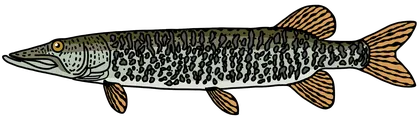
Long and cylindrical like a pike, but the pattern reverses: dark vertical bars or spots on a light silvery-olive background, and on some fish, no pattern at all.
The reliable checks are structural, not color-based. A muskie has scales on only the upper half of the cheek and the upper half of the gill cover — the lower halves are bare. A pike's cheek is fully scaled. Muskies also have six or more submandibular pores per side; pike have five or fewer. And a muskie's tail lobes are pointed, where a pike's are rounded.
Tiger muskie — the pike × muskie hybrid — show bold vertical bars, rounded tail lobes and intermediate scaling.
| Scientific name | Esox masquinongy |
|---|---|
| Family | Pikes (Esocidae) |
| Also known as | muskie, musky, the fish of 10,000 casts |
| Water type | Freshwater |
| Body type (app weight estimate) | Skinny |
Where muskellunge are found
Native to the Great Lakes basin, the Ohio and upper Mississippi drainages, and the St. Lawrence system. Stocked into reservoirs and rivers from Virginia and West Virginia through Kentucky, Tennessee and the upper South, and across Wisconsin, Minnesota, Michigan, New York, Pennsylvania and Ontario.
Commonly targeted in: Iowa, Illinois, Indiana, Kentucky, Maryland, Michigan, Minnesota, Missouri, North Carolina, North Dakota, Nebraska, New Hampshire, New Jersey, New York, Ohio, Pennsylvania, South Dakota, Tennessee, Virginia, Vermont, Wisconsin, West Virginia, Georgia, South Carolina, Colorado, Montana, Maine, Massachusetts, Connecticut, Ontario, Quebec, Manitoba.
Why this matters on a leaderboard. A muskellunge from one end of that range and one from the other are not competing on equal footing — climate, forage and growing season all shift what a good fish looks like. That is why Fish Masters Live runs both nationwide weekly boards and custom tournaments you can lock to a state, a region, or a single body of water.
Habitat and where to look
Muskies are edge and ambush predators that relate to the biggest and best structure in a system.
- Weed edges and cabbage beds — the classic summer haunt.
- Rock bars, humps and reefs — especially in fall.
- River current seams and deep holes — the entire pattern in river systems like the New, the French Broad and the St. Lawrence.
- Open water over the basin — in big clear lakes, muskies suspend over deep water following cisco and whitefish schools.
Muskies also relate strongly to prey abundance. In a lake with ciscoes, big muskies live where the ciscoes live.
Muskellunge season by season
Spring
Muskies spawn in shallow bays and marshy areas after pike, at roughly 49–59 °F. Most jurisdictions have a closed season through the spawn, opening in late May or June.
Early-season muskies are shallow and can be caught on smaller baits — bucktails, jerkbaits and soft plastics fished slower and smaller than the summer standard.
Summer
Weed edges, points and deep structure. Bucktails burned fast, topwater at dawn and dusk, and glide baits worked through openings.
Warm water speeds a muskie's metabolism and they feed more often, but summer is also the season where release mortality is highest. Many serious muskie anglers stop fishing when surface temperatures exceed about 80 °F.
Fall
The trophy season, universally. From late September through ice-up, big muskies feed heavily on large prey and move onto rock structure and deep edges.
This is big-bait season: large rubber baits, gliders, and trolled crankbaits. Cold, miserable November days on a big lake produce a disproportionate share of 50-inch fish.
Winter
In most of the range, muskie season is closed or the water is frozen. In open-water southern reservoirs and rivers, muskies remain catchable all winter on slowly worked large baits, and some of the biggest fish of the year come in December and January.
Techniques and baits that work
| Technique | When and why it works |
|---|---|
| Bucktail | The most-cast muskie bait. Burned fast along weed edges. Cover water and trigger reaction strikes. |
| Large rubber bait | 10–14" soft plastics fished with a rise-and-fall retrieve. The dominant modern fall big-fish bait. |
| Glide bait | A large jerkbait worked with sharp sweeps that make it dart side to side. Deadly on following fish. |
| Topwater | Large prop baits and walkers, low light and warm water. The most exciting way to catch one. |
| Trolling crankbaits | The most efficient way to cover a big lake, and the standard on the Great Lakes and the St. Lawrence. |
| The figure-eight | Not a bait — a technique. At the end of every single cast, put the rod tip in the water and trace a large, fast figure-eight. A meaningful share of all muskies caught eat at the boat. |
Go-to baits: Double-bladed bucktail · 12" rubber bait · Large glide bait · Topwater prop bait · Deep-diving crankbait
How to measure a muskellunge accurately
Muskie handling is a specialized skill and the gear is not optional. Before you cast, you should have in the boat:
- A large rubber net you can leave the fish in, in the water.
- Long-nose pliers, side cutters strong enough to cut a hook shank, and a jaw spreader.
- A measuring device long enough for a 50-inch fish.
Measure the fish in the net, in the water whenever possible. If you lift it, support it horizontally with one hand under the gill plate from below and one under the belly, and keep it out of the water for well under 30 seconds.
Lay the fish absolutely straight. On a 48-inch fish, a slight curve is a two-inch error. Their tail lobes are pointed; square them.
In the app: lay the fish flat, point your camera at it, and Fish Masters Live measures the length from the image and proposes the species automatically. You can drag the measurement box before you confirm, and every submission is reviewable — which is what makes a leaderboard built on photos actually trustworthy.
Handling and release
Muskie anglers have built the most rigorous release culture in North American fishing, and for good reason: populations are small, fish grow slowly, and a single trophy is a 15-to-20-year animal.
- Never hold a muskie vertically. It damages the vertebral column and internal organs.
- Never put fingers in a muskie's mouth without a jaw spreader.
- Unhook in the net, in the water.
- If a hook is buried badly, cut it. The hook will work out; a five-minute extraction will not.
- Revive fully — hold the fish upright in the water, moving, until it kicks free on its own. A big muskie can need several minutes.
- Stop fishing above about 80 °F surface temperature.
Common questions about muskellunge fishing
How do you tell a muskie from a northern pike?
Look at the cheek and gill cover. A muskie has scales only on the upper half of each; a pike's cheek is fully scaled. Coloration also reverses: muskies are dark markings on a light body, pike are light spots on a dark body. Muskie tail lobes are pointed, pike lobes rounded.
Is the 'fish of 10,000 casts' real?
As a figure of speech, yes — muskies are genuinely low-density apex predators and catch rates are low. Modern anglers with good electronics, big baits and a disciplined figure-eight do far better than that number suggests, but muskie fishing remains a pursuit measured in hours per fish, not fish per hour.
What is a trophy muskie?
Fifty inches. It is the benchmark across the entire range and represents a fish that is typically 15 to 20 years old. Forty inches is a good fish; 45 is very good; 50 is the line most muskie anglers spend years chasing.
Why do muskie anglers do a figure-eight at the end of every cast?
Muskies commonly follow a bait all the way to the boat without striking. A fast, wide figure-eight with the rod tip submerged keeps the bait moving and changes direction, which triggers a meaningful percentage of those followers to commit. Skipping it costs fish.
Muskellunge guides by region and season
Check your regulations. Seasons, size limits, slot limits and bag limits for muskellunge vary by state, province and often by individual water body, and they change. Always confirm the current rules with your state or provincial fish and wildlife agency before you fish.