How to identify a striped bass
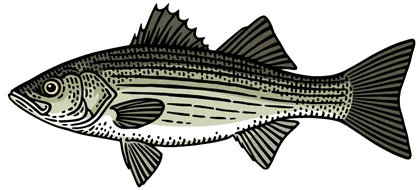
Silver-white flanks with seven or eight unbroken dark horizontal stripes running from gill to tail, a long streamlined body, and two clearly separate dorsal fins.
The stripes are the identification: on a true striped bass the lateral stripes are continuous and straight. Hybrid striped bass — "wipers," a striped bass × white bass cross stocked in many reservoirs — have broken, offset stripes and a deeper, more compressed body. White bass are smaller, deeper-bodied, and have only one distinct stripe reaching the tail.
| Scientific name | Morone saxatilis |
|---|---|
| Family | Temperate basses (Moronidae) |
| Also known as | striper, rockfish, linesider |
| Water type | Saltwater and freshwater |
| Body type (app weight estimate) | Average |
Where striped bass are found
Native along the Atlantic from the Canadian Maritimes to northern Florida, and introduced into the Gulf, the Pacific coast, and hundreds of inland reservoirs from Virginia to Texas to California. A landlocked striper in an Oklahoma reservoir and a migratory striper in Massachusetts are the same species living completely different lives.
Commonly targeted in: Maine, New Hampshire, Massachusetts, Rhode Island, Connecticut, New York, New Jersey, Delaware, Maryland, Virginia, North Carolina, South Carolina, Georgia, Florida, Alabama, Mississippi, Louisiana, Texas, California, Oregon, Washington, Arkansas, Oklahoma, Tennessee, Kentucky, Missouri, Kansas, Nebraska, Colorado, Arizona, New Mexico, Nevada, Utah, West Virginia, Pennsylvania, Ohio, Indiana, Illinois, Nova Scotia, New Brunswick, Prince Edward Island, Quebec.
Why this matters on a leaderboard. A striped bass from one end of that range and one from the other are not competing on equal footing — climate, forage and growing season all shift what a good fish looks like. That is why Fish Masters Live runs both nationwide weekly boards and custom tournaments you can lock to a state, a region, or a single body of water.
Habitat and where to look
Stripers are open-water pack hunters that orient to bait and current, not to cover.
Coastal: rips, inlets, rocky points, sod banks, jetties, sandbars with moving water, and the surf line. Tide is the single most important variable — a spot that is dead on slack water can be alive two hours into the ebb.
Reservoir: main-lake points, humps, river channel edges, and open water over deep basins wherever shad are schooled. Landlocked stripers are almost entirely bait-driven; find the shad, find the fish.
Both populations relate strongly to dissolved oxygen and temperature. In a stratified southern reservoir in August, stripers are compressed into a narrow band of water that is both cool enough and oxygenated enough — often 20–35 feet.
Striped Bass season by season
Spring
The coastal migration. Fish move north out of the Chesapeake and Hudson wintering grounds, and the run rolls up the coast from Virginia through New Jersey and New York into New England from roughly April into June. Herring, bunker and worm hatches all trigger it.
In reservoirs, stripers make a false spawning run up the major feeder rivers as water reaches the high 50s and low 60s. Fishing below the first dam or shoal on those rivers in spring is a regional institution from Georgia to Oklahoma.
Summer
Coastal fish spread through New England and the Canadian Maritimes and feed hard at night. Night fishing with eels, plugs and flies around structure and inlets is the classic summer approach.
Landlocked stripers go deep and get difficult. Look for the thermocline, use live bait — gizzard shad or herring — on downlines and planer boards, and fish very early. Summer surface-temperature stress makes catch and release genuinely dangerous for reservoir stripers, and many anglers switch species entirely in August.
Fall
The fall run is the best striper fishing of the year and one of the great events in American angling. Fish push south along the coast chasing bait, and blitzes — acres of stripers destroying peanut bunker on the surface — happen from Maine to Virginia from September into December.
In reservoirs, cooling water pulls stripers back up. Topwater over schooling fish on main-lake points in October and November is as good as it gets in freshwater.
Winter
Coastal fish concentrate in wintering areas — the Chesapeake, the Hudson, and warm-water discharges. Many jurisdictions close or restrict the season.
Southern reservoirs fish well all winter. Stripers pull into creek arms behind bait and can be caught on live shad, jigging spoons and swimbaits through the coldest months.
Techniques and baits that work
| Technique | When and why it works |
|---|---|
| Live bait on a downline | Gizzard shad, blueback herring or bunker. The most consistent way to catch reservoir stripers, and the standard on the coast for big fish. |
| Topwater pencil popper | For schooling fish and coastal blitzes. Long casts, aggressive retrieve. |
| Bucktail jig | The most versatile striper lure ever made. Works in the surf, in an inlet, and jigged vertically over reservoir fish. |
| Swimbait | 5–8" paddle tail on a heavy jighead. Matches gizzard shad and bunker, and covers water. |
| Trolling umbrella rigs / planer boards | Reservoir standard for finding scattered fish, and effective on the coast in spring and fall. |
| Live eel | The classic night bait for big coastal stripers around rocks and inlets. |
Go-to baits: Live gizzard shad · Bunker chunks · White bucktail · Pearl swimbait · Live eels
How to measure a striped bass accurately
Stripers are long, heavy and awkward — the hardest of the common species to get a clean, honest length on, especially from a boat deck alone.
Lay the fish flat with the mouth closed and the snout against the reference edge. Their tail is forked, so pinch it. On fish over about 30 inches, the body will curve if you do not straighten it, and a curved fish reads short by an inch or more.
Regulation slot limits on the Atlantic coast are enforced on total length, so getting a clean, honest measurement is not just a tournament matter — it is a legal one. Measure before you decide anything about the fish.
In the app: lay the fish flat, point your camera at it, and Fish Masters Live measures the length from the image and proposes the species automatically. You can drag the measurement box before you confirm, and every submission is reviewable — which is what makes a leaderboard built on photos actually trustworthy.
Handling and release
Big striped bass are one of the highest release-mortality species in North America when handled badly, and coastal populations have been under real pressure. Handle them accordingly:
- Never hold a striper over about 15 lb vertically by the jaw. Support the belly.
- Use circle hooks with bait — required in many Atlantic jurisdictions — and crush your barbs.
- Do not fish for them when surface water is above about 75 °F if you intend to release. Reservoir stripers in summer die at high rates regardless of how carefully you handle them.
- Revive fully in moving water before letting go.
Common questions about striped bass fishing
What is the difference between a striped bass and a hybrid striped bass?
A true striped bass has seven or eight unbroken horizontal stripes and a long, slim body. A hybrid — a striped bass crossed with a white bass, often called a wiper — has broken, offset stripes and a deeper, more compressed body. Hybrids rarely exceed about 20 lb; true stripers routinely exceed 40.
When is the best time to catch striped bass?
The fall run, from September through December along the Atlantic coast, is the peak. In inland reservoirs, October and November topwater fishing over schooling fish is the best window, with the spring river run a close second.
Do striped bass live in freshwater?
Yes. They are naturally anadromous — they spawn in freshwater rivers and live in salt — and they thrive permanently in freshwater when landlocked. Reservoirs from Virginia through Texas to California hold self-sustaining or stocked freshwater striper populations.
Why is catch-and-release mortality so high for striped bass?
Warm water and poor handling. Above about 75 °F, a striper's oxygen demand outstrips what warm water can supply, and a long fight plus a long air exposure often kills it hours later even if it swims away. Circle hooks, short fights, wet hands, belly support and cool water all substantially reduce it.
Striped Bass guides by region and season
Check your regulations. Seasons, size limits, slot limits and bag limits for striped bass vary by state, province and often by individual water body, and they change. Always confirm the current rules with your state or provincial fish and wildlife agency before you fish.