How to identify a red drum
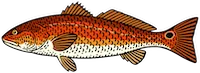
Copper-bronze to deep red on the back fading to a white belly, with a blunt, downturned mouth. The identifying feature is unmistakable: at least one black ocellus — a round eyespot — at the base of the tail. Many fish have several, and Louisiana redfish frequently carry a dozen or more.
Black drum, the close relative, are grey-black with vertical bars, have chin barbels, and lack the tail spot. Redfish have no barbels.
| Scientific name | Sciaenops ocellatus |
|---|---|
| Family | Drums and croakers (Sciaenidae) |
| Also known as | redfish, red, channel bass, spottail, bull red |
| Water type | Saltwater |
| Body type (app weight estimate) | Chunky |
Where red drum are found
The Atlantic and Gulf coasts from roughly Massachusetts south through Florida and west to the Texas–Mexico border, with the core of the fishery running from Virginia through Texas. Absent from the Pacific coast and from all inland waters except a few Texas reservoirs where they are stocked.
Commonly targeted in: Massachusetts, New York, New Jersey, Delaware, Maryland, Virginia, North Carolina, South Carolina, Georgia, Florida, Alabama, Mississippi, Louisiana, Texas.
Why this matters on a leaderboard. A red drum from one end of that range and one from the other are not competing on equal footing — climate, forage and growing season all shift what a good fish looks like. That is why Fish Masters Live runs both nationwide weekly boards and custom tournaments you can lock to a state, a region, or a single body of water.
Habitat and where to look
Shallow, and shallower than you think.
- Grass flats — turtle grass and shoal grass in 1–4 feet. Redfish root through it nose-down, which is what causes tailing.
- Marsh and spartina edges — the entire Louisiana, Mississippi, Georgia and South Carolina fishery. On a flooding tide redfish push right into the grass to eat fiddler crabs.
- Oyster bars — hard structure that holds shrimp and crabs. Fish the down-current side.
- Jetties, passes and beaches — larger fish, especially bull reds in fall.
- Docks and creek mouths — reliable winter and low-tide holding water.
Tide is the master variable. A flat that is empty on low tide can be covered in feeding fish two hours into the flood.
Red Drum season by season
Spring
Redfish spread out onto the flats as water warms through the 60s and 70s °F. Sight fishing improves as clarity comes back after winter.
Spring is a good numbers season for slot-size fish, and topwater fishing turns on as water passes about 70 °F.
Summer
Excellent early and late; tough in the middle of a hot day. Fish the first two hours of light on the flats with topwater and soft plastics, then move to deeper edges, docks and moving water.
In the Gulf, summer marsh fishing is at its best on a moving tide regardless of time of day.
Fall
The best redfish season, everywhere. Water cools, bait floods out of the marsh, and redfish feed heavily.
This is also bull red season — large mature fish over 30 inches school up in the passes, along the beaches and around jetties from the Carolinas to Texas from September into November. Big schools of bull reds in open water are one of the most spectacular sights in inshore fishing.
Winter
Underrated. Winter water is at its clearest of the year, and redfish school in large numbers in shallow protected water — the backs of creeks, mud flats that hold heat, and canal systems.
Sight fishing to schools of 50 to 200 redfish on a clear cold day in Louisiana or Florida is arguably the best redfish experience there is. Fish slowly; cold-water redfish will not chase.
Techniques and baits that work
| Technique | When and why it works |
|---|---|
| Soft plastic on a jighead | A 3–4" paddle tail or shrimp imitation on a 1/8–1/4 oz head. The most versatile redfish presentation, works on flats, in marsh and around structure. |
| Weedless gold spoon | The traditional redfish lure. Fishes over grass without fouling and can be seen from a distance in stained water. |
| Topwater walking bait | Over flats and along marsh edges in warm water. Redfish have a downturned mouth and often miss on the first try — keep it moving. |
| Live or cut bait | Live shrimp under a popping cork, or cut mullet on the bottom. The highest-percentage method for numbers and for bull reds. |
| Fly rod | An 8-weight with crab and shrimp patterns. Sight-casting to tailing redfish on a flat is one of the premier fly-fishing experiences in North America. |
| Popping cork | A shrimp or soft plastic under a concave cork you chug to imitate feeding fish. Deadly in stained water and over grass. |
Go-to baits: Live shrimp · Cut mullet · Gold weedless spoon · Paddle-tail soft plastic · Crab flies
How to measure a red drum accurately
Redfish are the most slot-regulated fish in the app. Nearly every state on the Gulf and South Atlantic coast manages redfish with a protected slot — commonly something like 18 to 27 inches, varying by state — and those slots are enforced on total length.
That makes an accurate measurement a legal requirement first and a leaderboard entry second. Measure before you decide anything about the fish.
Lay the fish flat with the mouth closed. Redfish tails are square to slightly rounded, so total length is straightforward, but square the tail against the reference edge anyway. Support the belly of a large fish; bull reds are heavy and thick-bodied.
Do not lay a redfish on hot sand or a hot boat deck. In a Gulf summer, a deck can exceed 130 °F and will burn a fish's skin in seconds.
In the app: lay the fish flat, point your camera at it, and Fish Masters Live measures the length from the image and proposes the species automatically. You can drag the measurement box before you confirm, and every submission is reviewable — which is what makes a leaderboard built on photos actually trustworthy.
Handling and release
Redfish are hardy and release well, which is one reason the fishery has recovered so strongly since the 1980s.
- Wet hands, wet deck, or wet mat.
- Support horizontally under the belly for anything over about 24 inches.
- Bull reds caught from deeper water in passes can suffer barotrauma. Watch for it.
- Circle hooks with bait dramatically reduce gut-hooking.
- Revive in moving water. A big red after a long fight in warm water needs real time.
Redfish were commercially overfished nearly to collapse in the 1980s and were rebuilt largely through gamefish status and strict slot limits. The rules exist for a reason and they worked.
Common questions about red drum fishing
What is the difference between a redfish and a red drum?
Nothing — they are the same fish. Red drum is the standard common name; redfish is the name used across the Gulf Coast; channel bass and spottail are regional names along the Atlantic. The scientific name is Sciaenops ocellatus.
What is a bull redfish?
A mature red drum over roughly 30 inches. Bull reds have left the estuaries for nearshore and coastal waters where they spawn, and they school heavily in passes, along beaches and around jetties in fall. Nearly every state requires their release, since large females carry most of the reproductive output.
Why do redfish have a spot on their tail?
The eyespot is thought to be a predator deflection mark — a strike aimed at the tail rather than the head lets the fish escape. Most redfish have one spot per side; some have many, and multi-spotted fish are especially common in Louisiana.
What tide is best for redfish?
Moving water, in either direction. A flooding tide pushes redfish up into marsh grass and onto flats to feed; a falling tide pulls bait out of the marsh and stacks redfish at creek mouths and drains. Slack tide is the slowest fishing of the cycle.
Red Drum guides by region and season
Check your regulations. Seasons, size limits, slot limits and bag limits for red drum vary by state, province and often by individual water body, and they change. Always confirm the current rules with your state or provincial fish and wildlife agency before you fish.