How to identify a rainbow trout
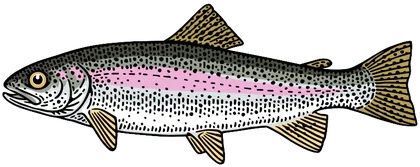
Silvery to olive-green with heavy black spotting over the back, flanks, dorsal fin and tail, plus the pink-to-red lateral band that gives the species its name. The spots extend onto the tail in a radiating pattern — a useful separation from brown trout, whose tail is largely unspotted.
Stream-resident rainbows are darker and more heavily marked. Lake and sea-run fish go bright chrome and the pink band fades almost completely. A rainbow's mouth does not extend past the rear of the eye; a brown trout's often does.
| Scientific name | Oncorhynchus mykiss |
|---|---|
| Family | Salmonids (Salmonidae) |
| Also known as | bow, redband, rainbow |
| Water type | Freshwater |
| Body type (app weight estimate) | Skinny |
Where rainbow trout are found
Native to Pacific drainages from Alaska to northern Mexico, and stocked into cold water in all 50 states and every Canadian province. If a state has a put-and-take trout program, it stocks rainbows.
Commonly targeted in: Alaska, Alabama, Arkansas, Arizona, California, Colorado, Connecticut, Delaware, Georgia, Iowa, Idaho, Illinois, Indiana, Kansas, Kentucky, Massachusetts, Maryland, Maine, Michigan, Minnesota, Missouri, Montana, North Carolina, North Dakota, Nebraska, New Hampshire, New Jersey, New Mexico, Nevada, New York, Ohio, Oklahoma, Oregon, Pennsylvania, Rhode Island, South Carolina, South Dakota, Tennessee, Texas, Utah, Virginia, Vermont, Washington, Wisconsin, West Virginia, Wyoming, Alberta, British Columbia, Manitoba, New Brunswick, Newfoundland and Labrador, Nova Scotia, Ontario, Prince Edward Island, Quebec, Saskatchewan, Yukon, Northwest Territories.
Why this matters on a leaderboard. A rainbow trout from one end of that range and one from the other are not competing on equal footing — climate, forage and growing season all shift what a good fish looks like. That is why Fish Masters Live runs both nationwide weekly boards and custom tournaments you can lock to a state, a region, or a single body of water.
Habitat and where to look
Cold, clean, oxygenated water. Rainbows are most comfortable between about 50 and 65 °F and begin to suffer above 70 °F.
- Freestone rivers — riffle tailouts, seams beside fast water, plunge pools, undercut banks.
- Tailwaters — the cold discharge below a bottom-release dam, which creates trout habitat hundreds of miles south of where trout naturally belong. Arkansas, Tennessee and Georgia trout fishing exists almost entirely because of tailwaters.
- Lakes and reservoirs — cruise the thermocline in summer; shallow flats and inlets in spring and fall.
- Stocked ponds — near the stocking point for the first week, then dispersed toward inflows, springs and shade.
Rainbow Trout season by season
Spring
Rainbows spawn in spring — roughly February through May depending on latitude and elevation — on gravel in moving water. Pre-spawn and post-spawn fish feed hard.
This is also the peak stocking season in most states, and the surest way to find fish is to read your state agency's stocking schedule, which is published publicly and updated weekly. Hatches begin: blue-winged olives, then caddis.
Summer
Early and late. Through the middle of the day, cold water is the whole game — fish the deepest pools, spring seeps, shaded runs and the very top of the system where the water is coldest.
In lakes, rainbows follow the thermocline down. Trolling small spoons and spinners on lead-core or downriggers is the standard. Terrestrial season on the rivers — hoppers, ants and beetles — starts in July and runs into September and is some of the most fun trout fishing of the year.
Fall
Water cools, fish move back up, and the bite improves steadily through September and October. Blue-winged olives return, and streamer fishing gets excellent as trout put on weight.
Fall stocking rounds happen in many states, and lightly pressured autumn fish are far more willing than the same fish in July.
Winter
Rainbows feed all winter in tailwaters and spring creeks, where water temperature barely changes. Tiny midge patterns fished deep are the tailwater standard from December through March.
In freestone rivers, fish concentrate in slow deep pools and eat very little. In the North, rainbows are a solid ice-fishing target on stocked lakes using small jigs tipped with a waxworm.
Techniques and baits that work
| Technique | When and why it works |
|---|---|
| Nymphing | Dead-drift a weighted nymph under an indicator or on a tight line. Trout take the overwhelming majority of their food subsurface — this is the highest-percentage fly method by a wide margin. |
| Inline spinner | A 1/16–1/8 oz spinner cast upstream and retrieved just faster than the current. The most effective search lure for stream trout, and easy for beginners. |
| Dry fly | Match the hatch and drift drag-free. Less productive than nymphing overall but the reason many anglers fish at all. |
| Streamer | Woolly buggers and sculpin patterns swung or stripped. Big-fish method, especially in high or off-color water. |
| Bait under a float | Where legal, a nightcrawler, salmon egg or dough bait suspended off the bottom is the most effective way to catch stocked rainbows. |
| Trolling spoons | Lake fishing through summer. Small flutter spoons behind a dodger at 1.5–2.5 mph. |
Go-to baits: Nightcrawler · Salmon eggs · Gold inline spinner · Pheasant tail nymph · Olive woolly bugger
How to measure a rainbow trout accurately
Trout are slender, soft-bodied and slippery — the species most often measured badly.
Wet your hands and the surface before the fish touches it. A dry hand strips the protective slime coat, and on a trout that is a real mortality risk, not a technicality.
Their tail is only slightly forked, so pinching the lobes changes the number less than it does on a smallmouth, but the body flexes easily. Support it along its full length so it lies straight. Keep the mouth closed; a gaping trout jaw can add half an inch.
Shoot fast. If the measurement is not clean in ten seconds, put the fish back in the water and try again.
In the app: lay the fish flat, point your camera at it, and Fish Masters Live measures the length from the image and proposes the species automatically. You can drag the measurement box before you confirm, and every submission is reviewable — which is what makes a leaderboard built on photos actually trustworthy.
Handling and release
Trout have the lowest tolerance for air exposure of any species in the app. The research is consistent: every additional ten seconds out of water measurably increases delayed mortality, and the effect compounds above 65 °F.
- Keep the fish in the water, in the net, until the moment you measure.
- Never squeeze behind the gill plate.
- Never touch the gills.
- Barbless hooks, and cut the line on a deep hook rather than digging.
- If water is above about 68 °F, stop fishing for trout. Several western states now issue "hoot owl" closures for exactly this reason.
Common questions about rainbow trout fishing
What is the difference between a rainbow trout and a steelhead?
They are the same species, Oncorhynchus mykiss. A steelhead is a rainbow that migrates to the ocean — or to a Great Lake — grows large on rich saltwater forage, and returns to freshwater to spawn. Steelhead are chrome-bright and much larger; resident rainbows keep their spots and color.
What is the best bait for rainbow trout?
For stocked fish, a nightcrawler or a scented dough bait fished on the bottom or under a float. For wild fish, a small nymph dead-drifted or a 1/8 oz inline spinner. Check local rules first — many trout waters are artificial-lures-only or fly-only.
What water temperature is too warm for trout?
Rainbows are stressed above about 68 °F and mortality rises steeply above 70 °F even with careful catch and release. Carry a thermometer. If the water is warm, fish for bass instead and come back in the fall.
Where can I find out when trout are stocked near me?
Every state fish and wildlife agency publishes a stocking schedule, most of them weekly and searchable by county or water body. It is the single most useful free resource in put-and-take trout fishing and almost nobody uses it.
Rainbow Trout guides by region and season
Check your regulations. Seasons, size limits, slot limits and bag limits for rainbow trout vary by state, province and often by individual water body, and they change. Always confirm the current rules with your state or provincial fish and wildlife agency before you fish.