How to identify a largemouth bass
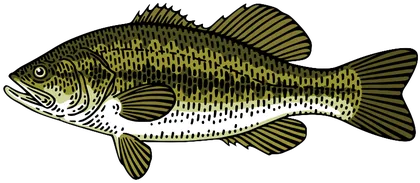
Largemouth are olive to dark green with a ragged horizontal stripe running from gill to tail. The tell that separates them from every other black bass is the jaw: the upper jaw extends past the back of the eye when the mouth is closed. Smallmouth and spotted bass jaws stop at or before the rear of the eye.
Two other marks worth knowing:
- The dorsal fin is deeply notched — almost two separate fins — where a smallmouth's is shallowly notched.
- Largemouth have no rough tooth patch on the tongue; spotted bass do.
Florida-strain fish (M. floridanus), now recognized as a separate species, look nearly identical to northern largemouth but grow considerably larger and are the reason Florida, Texas and California produce so many double-digit fish.
| Scientific name | Micropterus salmoides / Micropterus floridanus |
|---|---|
| Family | Sunfish family (Centrarchidae) |
| Also known as | bucketmouth, green trout, black bass, hawg |
| Water type | Freshwater |
| Body type (app weight estimate) | Average |
Where largemouth bass are found
Every state in the lower 48 plus Hawaii, and across southern Ontario, Quebec and the Maritimes. One of the most widely stocked freshwater gamefish on earth.
Commonly targeted in: Alabama, Arkansas, Arizona, California, Colorado, Connecticut, Delaware, Florida, Georgia, Iowa, Idaho, Illinois, Indiana, Kansas, Kentucky, Louisiana, Massachusetts, Maryland, Maine, Michigan, Minnesota, Missouri, Mississippi, Montana, North Carolina, North Dakota, Nebraska, New Hampshire, New Jersey, New Mexico, Nevada, New York, Ohio, Oklahoma, Oregon, Pennsylvania, Rhode Island, South Carolina, South Dakota, Tennessee, Texas, Utah, Virginia, Vermont, Washington, Wisconsin, West Virginia, Wyoming, Hawaii, Ontario, Quebec, New Brunswick, Nova Scotia.
Why this matters on a leaderboard. A largemouth bass from one end of that range and one from the other are not competing on equal footing — climate, forage and growing season all shift what a good fish looks like. That is why Fish Masters Live runs both nationwide weekly boards and custom tournaments you can lock to a state, a region, or a single body of water.
Habitat and where to look
Largemouth are cover-oriented ambush feeders. They will not sit in open water without a reason. Look for:
- Vegetation — hydrilla, milfoil, lily pads, coontail. Grass is the single most productive largemouth cover in the country.
- Wood — laydowns, standing timber, dock pilings, brush piles.
- Hard structure transitions — the point where a gravel bank meets mud, a channel swing bank, riprap along a causeway.
- Shade lines — under docks, overhanging willows, bridge shadows. In bright sun a bass will hold on the shaded side of anything.
They tolerate warm, low-oxygen, stained water better than any other black bass, which is why they thrive in farm ponds, canals and shallow reservoirs that smallmouth cannot survive in.
Largemouth Bass season by season
Spring
Pre-spawn is the best big-fish window of the year. As water climbs through the mid-50s °F, bass stage on the first drop off spawning flats — secondary points, creek channel bends, isolated stumps in 6–12 feet. Lipless crankbaits, jerkbaits and a slow-rolled spinnerbait get bit here.
Once water holds around 60–65 °F fish move onto beds in protected pockets, usually on the north side of a lake first because it warms fastest. Post-spawn fish drift to the first deep cover outside the bedding flat and are notoriously hard to catch for a week or two.
Summer
Two populations split: shallow fish that live in grass and shade all summer, and offshore fish that group up on ledges, humps and channel edges in 12–25 feet.
Early and late, work topwater — walking baits, buzzbaits, frogs over mats. Through the middle of the day either punch heavy cover with a 3/4–1 oz weight or go find the offshore school with a deep crankbait, a football jig or a drop-shot. Night fishing with a big black spinnerbait or a Colorado-bladed bait is legitimately effective in the South.
Fall
Bass follow shad into the backs of creeks. This is the most predictable pattern of the year: find the bait, find the fish. Cover water fast with a squarebill crankbait, a spinnerbait or a swim jig, and watch for surface activity.
As water drops through the 50s the shallow bite gets better and better, then the fish slide back out to wintering structure once it goes below about 50 °F.
Winter
In the South, largemouth stay catchable all winter — slow-rolled jigs, jerkbaits worked with long pauses, and a hair jig or blade bait on steep bluff banks. In the North, largemouth go semi-dormant in the deepest available basin and are mostly a bycatch through the ice.
Winter is a big-fish season everywhere it is fishable. Fewer bites, larger average size.
Techniques and baits that work
| Technique | When and why it works |
|---|---|
| Texas-rigged soft plastic | A 4–7" worm or creature bait with a 3/16–1/2 oz bullet weight. The most versatile largemouth presentation there is — it fishes grass, wood, rock and docks without hanging up. |
| Jig and trailer | A 3/8–1/2 oz flipping or football jig with a craw trailer. Best big-fish bait in freshwater, and it works twelve months a year. |
| Squarebill crankbait | For cover-contact fishing in 1–6 feet. Deflect it off wood and rock — the deflection is what triggers the strike, not the retrieve. |
| Topwater frog | Over matted grass and lily pads from late spring through fall. Wait a full beat after the blow-up before you swing. |
| Spinnerbait | Wind, stain and shallow cover. A 3/8 oz double-willow in clear water, a Colorado/Indiana blade in dirty water. |
| Drop-shot / Ned rig | Finesse cleanup for pressured water, cold fronts and clear lakes. Slow down, use 6–10 lb fluorocarbon, and fish it on the bottom. |
Go-to baits: Green pumpkin plastics · Black-and-blue jig · Shad-pattern crankbait · Watermelon-red flake worm · White spinnerbait
How to measure a largemouth bass accurately
Largemouth are the easiest species to get a clean measurement on, because their body is deep and their tail is broad and easy to square up.
Lay the fish flat on the mat or ground with the mouth closed and the jaw against the reference edge. Pinch the tail lobes together to get the true maximum length rather than the fork. On big fish, keep the belly supported — a heavy female that folds will read short.
Because the mouth is so large, do not let the jaw hang open in the frame. An open mouth adds up to an inch of false length and is the most common reason a submission gets adjusted by a moderator.
In the app: lay the fish flat, point your camera at it, and Fish Masters Live measures the length from the image and proposes the species automatically. You can drag the measurement box before you confirm, and every submission is reviewable — which is what makes a leaderboard built on photos actually trustworthy.
Handling and release
Largemouth handle release well if you support them properly. Grip the lower jaw vertically for fish under about 3 lb; for anything bigger, use one hand on the jaw and one under the belly to avoid stressing the jaw joint.
Keep them wet, keep the handling under 30 seconds, and if you have caught the fish from more than about 20 feet down, expect barotrauma — a distended stomach or bulging eyes — and either vent or fizz the fish or move shallower. In summer, water over 85 °F sharply increases delayed mortality, so fish early and release fast.
Common questions about largemouth bass fishing
What is the best time of day to catch largemouth bass?
First light and the last hour of daylight are the highest-percentage windows most of the year, because bass move shallow to feed in low light. In cold water — under about 55 °F — the middle of the afternoon is often better, since that is when the shallows are warmest.
What size largemouth bass is considered big?
It depends entirely on where you fish. In the northern US and Canada a 5 lb / 20-inch fish is a genuine trophy. In Florida, Texas and California, a trophy conversation starts around 10 lb, and 20-inch fish are common. This is exactly why length-based leaderboards get filtered by region.
Do largemouth bass bite in the winter?
Yes, wherever the water stays above roughly 40 °F. They feed less often and hold deeper, but winter produces some of the largest fish of the year. Slow presentations — a jig dragged on the bottom, or a suspending jerkbait with long pauses — are the standard approach.
What is the difference between largemouth and smallmouth bass?
Jaw length is the reliable field mark: a largemouth's upper jaw extends past the rear of the eye, a smallmouth's does not. Beyond that, largemouth are green with a horizontal stripe and live in warm vegetated water; smallmouth are bronze with vertical bars and prefer cool, clear, rocky water.
Largemouth Bass guides by region and season
Check your regulations. Seasons, size limits, slot limits and bag limits for largemouth bass vary by state, province and often by individual water body, and they change. Always confirm the current rules with your state or provincial fish and wildlife agency before you fish.