How to identify a crappie
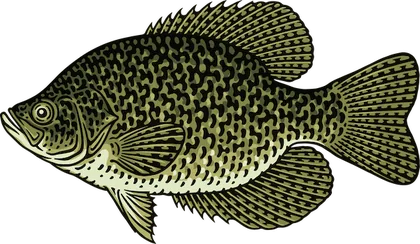
Deep, silvery, laterally compressed with dark mottling. The two species split cleanly:
- Black crappie — irregular scattered black speckling with no pattern, and seven or eight dorsal spines.
- White crappie — dark markings arranged in vertical bars, a more elongated body, and five or six dorsal spines.
Count the spines. It is the only reliable field mark, and it takes two seconds.
| Scientific name | Pomoxis annularis / Pomoxis nigromaculatus |
|---|---|
| Family | Sunfish family (Centrarchidae) |
| Also known as | specks, papermouth, slab, sac-a-lait, calico bass |
| Water type | Freshwater |
| Body type (app weight estimate) | Panfish |
Where crappie are found
Both white and black crappie are found across the eastern, central and southern United States and up into southern Canada, with introduced populations throughout the West. Black crappie tolerate clearer, cooler water; white crappie handle turbidity better and dominate stained reservoirs.
Commonly targeted in: Alabama, Arkansas, Arizona, California, Colorado, Connecticut, Delaware, Florida, Georgia, Iowa, Idaho, Illinois, Indiana, Kansas, Kentucky, Louisiana, Massachusetts, Maryland, Maine, Michigan, Minnesota, Missouri, Mississippi, Montana, North Carolina, North Dakota, Nebraska, New Hampshire, New Jersey, New Mexico, Nevada, New York, Ohio, Oklahoma, Oregon, Pennsylvania, Rhode Island, South Carolina, South Dakota, Tennessee, Texas, Utah, Virginia, Vermont, Washington, Wisconsin, West Virginia, Wyoming, Ontario, Quebec, Manitoba, Saskatchewan, British Columbia.
Why this matters on a leaderboard. A crappie from one end of that range and one from the other are not competing on equal footing — climate, forage and growing season all shift what a good fish looks like. That is why Fish Masters Live runs both nationwide weekly boards and custom tournaments you can lock to a state, a region, or a single body of water.
Habitat and where to look
Crappie suspend around vertical structure in open water more than they relate to the bottom.
- Brush piles and standing timber — the single most productive crappie structure in reservoirs.
- Bridge pilings and dock posts — vertical cover in deep water.
- Creek channel edges — crappie migrate along channels between deep and shallow water and hold on the bends.
- Deep basin suspension — in winter and midsummer they suspend over open water, often 15–25 feet down over 30 feet of water.
Depth control is the entire game. A crappie will come up to eat but very rarely goes down, so present above them.
Crappie season by season
Spring
The peak. As water climbs into the low 60s °F, crappie move onto shallow cover — buck brush, laydowns, boat docks and shoreline timber — in 2–8 feet to spawn. This is when the whole country goes crappie fishing.
The pre-spawn staging bite, in the ditches and channel swings just outside the spawning pockets, is when the largest fish of the year are caught.
Summer
Fish pull out to deeper brush and suspend along creek and river channel edges in 12–25 feet. Nighttime dock-light fishing under submerged lights is a major southern summer fishery.
Spider rigging and long-line trolling with small jigs cover water and find suspended schools.
Fall
Crappie follow shad back into the creeks, mirroring the bass migration. October and November fishing can be excellent and is far less crowded than spring.
Fish are heavy going into winter and the average size is good.
Winter
In the South, deep brush and bridge pilings hold crappie all winter and produce some of the largest fish of the year on a slowly presented jig.
In the North, crappie are a top ice-fishing target. They suspend over the basin and roam, which makes them a hole-hopping fish rather than a sit-and-wait fish.
Techniques and baits that work
| Technique | When and why it works |
|---|---|
| Jig under a float | A 1/16–1/32 oz jig with a soft plastic body, suspended precisely at the fish's depth. The most common crappie presentation in the country. |
| Live minnow | A small shiner on a #2 Aberdeen hook. Still the highest-percentage bait, and Aberdeen hooks bend free when you snag brush. |
| Vertical jigging with forward-facing sonar | The modern approach: locate individual suspended fish, drop the jig to their level, and watch them react. |
| Spider rigging | Multiple long rods on a front rack, moving slowly, presenting jigs or minnows at set depths. Covers water and finds schools. |
| Long-line trolling | Pulling small jigs behind the boat at 0.8–1.5 mph. The best way to find scattered summer and fall fish. |
Go-to baits: Live minnow · 1/16 oz chartreuse jig · Blue-and-white tube · Pink and white jig · Small hair jig
How to measure a crappie accurately
Crappie are called papermouths for a reason: the membrane around the mouth is thin and tears easily, which matters both for landing them and for measuring them.
Do not lift a crappie by the lower jaw. Support the body. A jaw-lifted crappie can tear free and land on the deck.
Lay the fish flat with the dorsal relaxed and the tail squared. Crappie tails are moderately forked and the difference between fork and total length is meaningful on a 14-inch fish.
Their bodies are thin and deep, so they lie flat easily — crappie are among the easiest species to get a clean, repeatable measurement on.
In the app: lay the fish flat, point your camera at it, and Fish Masters Live measures the length from the image and proposes the species automatically. You can drag the measurement box before you confirm, and every submission is reviewable — which is what makes a leaderboard built on photos actually trustworthy.
Handling and release
Crappie are moderately hardy but suffer badly from two things:
Barotrauma. Crappie pulled from 25+ feet frequently cannot swim back down. If you are fishing deep brush and releasing fish, watch for a distended stomach and fizz or vent as needed — or fish shallower.
Deep hooking on minnows. A crappie inhales a minnow completely. Set fast, and if it goes deep, cut the line.
Handle by supporting the body, not by the jaw, and keep the fish wet.
Common questions about crappie fishing
What is the difference between black and white crappie?
Count the dorsal spines: black crappie have seven or eight, white crappie five or six. Black crappie are covered in irregular scattered speckling; white crappie have their markings arranged in vertical bars and a slightly more elongated body.
What depth do crappie suspend at?
It varies by season and lake, but the rule is that crappie suspend above the structure they relate to and feed upward. In summer and winter, 12 to 25 feet down over deeper water is typical. Always present your bait at or slightly above the fish, never below.
When is the best time to catch crappie?
Spring, when they move shallow to spawn — roughly when water hits the low 60s Fahrenheit. Pre-spawn staging fish just outside the spawning pockets produce the biggest crappie of the year.
Why are crappie called papermouths?
The membrane around their mouth is unusually thin, and a hook will tear free if you fight the fish hard or lift it by the jaw. Use a soft rod, keep steady pressure, and net or hand-land them by the body.
Crappie guides by region and season
Check your regulations. Seasons, size limits, slot limits and bag limits for crappie vary by state, province and often by individual water body, and they change. Always confirm the current rules with your state or provincial fish and wildlife agency before you fish.