How to identify a sunfish
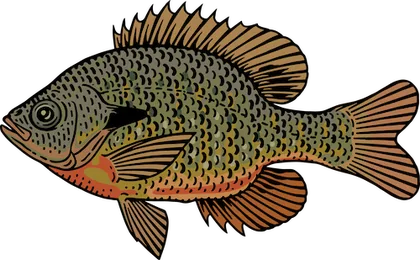
All are deep-bodied, laterally compressed Lepomis. Telling them apart comes down to the gill flap and flank pattern:
- Pumpkinseed — orange-red crescent on the edge of the gill flap; wavy blue lines on the cheek; orange spots on the flank.
- Redear (shellcracker) — a bright red or orange edge on an otherwise dark flap; flanks speckled rather than barred; the largest of the common sunfish.
- Longear — a long, flexible, black flap edged in white; brilliant orange belly and blue face markings.
- Green sunfish — larger mouth than the others, blue-green wavy lines on the face, and yellow-orange fin edges. Tolerates water nothing else will.
- Warmouth — large mouth, red eye, mottled brown body. Often mistaken for a rock bass.
| Scientific name | Lepomis spp. |
|---|---|
| Family | Sunfish family (Centrarchidae) |
| Also known as | pumpkinseed, redear, shellcracker, longear, bream |
| Water type | Freshwater |
| Body type (app weight estimate) | Panfish |
Where sunfish are found
As a group, sunfish occupy every state and most of southern Canada. Individual species have narrower ranges: pumpkinseed are northern and eastern, redear are southern, longear are central, and green sunfish are nearly everywhere.
Commonly targeted in: Alabama, Arkansas, Arizona, California, Colorado, Connecticut, Delaware, Florida, Georgia, Iowa, Idaho, Illinois, Indiana, Kansas, Kentucky, Louisiana, Massachusetts, Maryland, Maine, Michigan, Minnesota, Missouri, Mississippi, Montana, North Carolina, North Dakota, Nebraska, New Hampshire, New Jersey, New Mexico, Nevada, New York, Ohio, Oklahoma, Oregon, Pennsylvania, Rhode Island, South Carolina, South Dakota, Tennessee, Texas, Utah, Virginia, Vermont, Washington, Wisconsin, West Virginia, Wyoming, Ontario, Quebec, Manitoba, Saskatchewan, British Columbia, New Brunswick, Nova Scotia.
Why this matters on a leaderboard. A sunfish from one end of that range and one from the other are not competing on equal footing — climate, forage and growing season all shift what a good fish looks like. That is why Fish Masters Live runs both nationwide weekly boards and custom tournaments you can lock to a state, a region, or a single body of water.
Habitat and where to look
Broadly the same as bluegill — warm water, cover, hard bottom for spawning — with meaningful species-level differences:
- Redear are bottom feeders that eat snails and small mussels. They hold deeper than bluegill, on hard shell-bottom flats, and are usually caught near the bottom rather than suspended. That is where "shellcracker" comes from.
- Pumpkinseed favor thicker vegetation and cooler water than bluegill.
- Green sunfish live in ditches, farm ponds, creeks and anywhere with poor water quality.
- Longear are creek and small-river fish through the central US.
Sunfish season by season
Spring
The spawn, roughly the same temperature window as bluegill (mid-60s to mid-70s °F), with redear typically spawning earliest — sometimes a full month before bluegill in the South.
Redear spawning waves in Florida and the Deep South in March are a major regional fishery.
Summer
Redear stay deep on shell bottom and are consistently taken on a small worm or a jig fished on the bottom in 8–20 feet. Pumpkinseed and longear stay shallow in vegetation.
Green sunfish will eat anything, anywhere, all summer, and are the reason so many kids catch their first fish.
Fall
Cooling water pulls sunfish shallower again and improves the bite through October in most of the country.
Winter
Pumpkinseed are a common and welcome ice-fishing bycatch in the North. Redear largely shut down in cold water and are a warm-season fishery.
Techniques and baits that work
| Technique | When and why it works |
|---|---|
| Worm on the bottom (redear) | A red worm or piece of crawler on a small hook with a split shot, fished on hard shell bottom. The standard shellcracker method. |
| Small jig under a float | Universal panfish rig for pumpkinseed, longear and green sunfish in shallow cover. |
| Fly rod with a wet fly | A small soft hackle or nymph is deadly on all sunfish, and a foam spider on top is more fun than it should be. |
| Micro crankbait | For larger green sunfish and warmouth, which are more predatory than their cousins. |
Go-to baits: Red worm · Cricket · Waxworm · Small soft hackle fly · 1/32 oz jig
How to measure a sunfish accurately
Sunfish measurement follows the bluegill rules: flat, dorsal relaxed, tail squared, mouth closed.
Because the group contains several species that look alike, species identification is where sunfish submissions most often go wrong. Frame the fish so the gill flap is clearly visible in the image — that flap is the diagnostic feature for pumpkinseed, redear and longear, and it is what both automatic detection and a human moderator will use.
If you are unsure which sunfish you have, the app's species library lets you set it manually. Guessing on a leaderboard entry is worse than looking it up.
In the app: lay the fish flat, point your camera at it, and Fish Masters Live measures the length from the image and proposes the species automatically. You can drag the measurement box before you confirm, and every submission is reviewable — which is what makes a leaderboard built on photos actually trustworthy.
Handling and release
Small hooks, quick sets, wet hands, and cut the line on a deep hook. Same as bluegill.
Green sunfish and warmouth have larger mouths and are less prone to deep-hooking; redear, with their small mouths and bottom-feeding habit, are more prone to it. Use a #8 hook rather than a #6 and set on the first tick.
Common questions about sunfish fishing
What is the difference between a pumpkinseed and a bluegill?
The gill flap. A pumpkinseed's flap has a bright orange-red crescent on its edge; a bluegill's is solid black with no colored margin. Pumpkinseeds also have wavy blue lines on the cheek and orange spots on the flank, where bluegill are barred.
What is a shellcracker?
A redear sunfish. The nickname comes from its diet — it eats snails and small mussels off hard bottom, crushing shells with pharyngeal teeth. Redear are the largest common sunfish and are caught on the bottom, not suspended like bluegill.
Are green sunfish good to catch?
They are aggressive, easy to catch, and tolerate water quality that kills other fish, which makes them great for teaching kids. They also overpopulate and stunt small ponds, so in many waters keeping them is actively encouraged.
What is the biggest kind of sunfish?
Among the common Lepomis, redear grow the largest — 12-inch redear are caught regularly and the species produces the heaviest fish in the group. Bluegill run a close second.
Check your regulations. Seasons, size limits, slot limits and bag limits for sunfish vary by state, province and often by individual water body, and they change. Always confirm the current rules with your state or provincial fish and wildlife agency before you fish.