How to identify a peacock bass
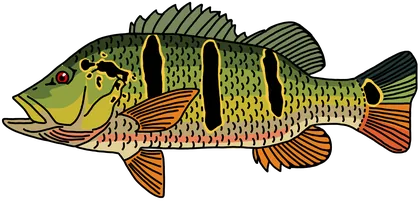
Golden-olive to bright yellow-green with three dark vertical bars on the flank and, most distinctively, a black ocellus — a false eyespot ringed in white — at the base of the tail. Breeding males develop a pronounced nuchal hump on the forehead and go brilliant orange and green.
They are unmistakable in Florida water. Nothing else in a Miami canal has that tail spot.
| Scientific name | Cichla ocellaris |
|---|---|
| Family | Cichlids (Cichlidae) |
| Also known as | butterfly peacock, pavon, tucunaré |
| Water type | Freshwater (tropical) |
| Body type (app weight estimate) | Average |
Where peacock bass are found
In the United States, butterfly peacock bass are established only in the canal systems of southeast Florida — Miami-Dade, Broward and southern Palm Beach counties — plus Hawaii and Puerto Rico. They were deliberately stocked by the Florida Fish and Wildlife Conservation Commission beginning in 1984 to control exotic forage fish, and they cannot survive water below about 60 °F.
Commonly targeted in: Florida, Hawaii.
Why this matters on a leaderboard. A peacock bass from one end of that range and one from the other are not competing on equal footing — climate, forage and growing season all shift what a good fish looks like. That is why Fish Masters Live runs both nationwide weekly boards and custom tournaments you can lock to a state, a region, or a single body of water.
Habitat and where to look
Southeast Florida's urban canal network, rock pits, and connected lakes. Peacocks are sight predators and want:
- Clear or lightly stained water — they hunt visually and are far less effective in muddy water.
- Structure with an edge — canal culverts, bridge shadow lines, seawalls, dock pilings, spillways.
- Current — a culvert dumping into a canal at a spillway concentrates bait and peacocks together.
They stay in the upper part of the water column far more than largemouth do, and they patrol rather than sit still.
Peacock Bass season by season
Spring
The best season of the year. Peacocks spawn from roughly March through July, clearing sandy or hard-bottom beds in shallow water along canal edges. Paired-up fish are aggressive and territorial and will destroy anything that comes near the nest.
Because the fishery is so visual, spring is also when sight fishing works best. Polarized glasses and a slow drift down a canal bank will find fish.
Summer
Peacocks stay active through the heat — they are tropical fish and the Florida summer is their natural condition. Topwater in the first two hours of light is outstanding.
Through the day, work shade lines and moving water. Live shiners fished under a float around culverts are the traditional and still the most effective approach for numbers.
Fall
A continuation of summer with slightly cooler mornings and gradually shorter days. Fishing stays strong through November in a normal year, and the crowds thin considerably after the summer.
Winter
The vulnerable season. Peacock bass shut down below about 65 °F and begin dying below roughly 60 °F, which is why the Florida population still tracks with cold-winter years — hard freezes in 2010 knocked the fishery back significantly.
On a mild winter day the bite can be excellent in the afternoon once the sun has been on the water. On a cold front, do not bother — go catch largemouth or a snakehead instead.
Techniques and baits that work
| Technique | When and why it works |
|---|---|
| Live shiner under a float | The highest-percentage method by a wide margin. A 3–4" shiner near a culvert or shade line will get eaten. |
| Topwater walking bait | Early morning along seawalls and canal edges. Peacock blowups are violent even by topwater standards. |
| Jerkbait / minnow plug | Fast, erratic retrieves. Peacocks chase — a bait that stops for too long often gets refused. |
| Small swimbait | 3–4" paddle tail on a light jighead, burned just under the surface along a shade line. |
| Fly rod | Southeast Florida peacocks are a legitimate 7–8 weight fly fishery. Poppers and baitfish streamers in chartreuse or olive. |
Go-to baits: Live shiners · Chartreuse topwater · Silver jerkbait · White paddle-tail swimbait
How to measure a peacock bass accurately
Peacocks are compact and deep-bodied, which makes them easy to lay flat but easy to under-measure if you do not extend the tail fully.
Two species-specific notes: their gill plates are sharp — handle from the top of the head rather than the gill cover — and their scales come off easily, so a wet mat matters more than usual. Do not set them on hot concrete along a canal bank; that is the fastest way to kill a fish you intended to release.
In the app: lay the fish flat, point your camera at it, and Fish Masters Live measures the length from the image and proposes the species automatically. You can drag the measurement box before you confirm, and every submission is reviewable — which is what makes a leaderboard built on photos actually trustworthy.
Handling and release
Peacock bass do not survive rough handling in warm water. Keep them wet, skip the long photo session, and get them back quickly.
They are also non-native, which means release rules vary — Florida has specific bag and slot regulations for butterfly peacock bass, and they cannot be transported live. Check current FWC regulations before you fish.
Common questions about peacock bass fishing
Where can you catch peacock bass in the United States?
Only in southeast Florida — the Miami-Dade, Broward and southern Palm Beach county canal systems — plus Hawaii and Puerto Rico. They cannot survive winter water temperatures anywhere else in the country.
Are peacock bass actually bass?
No. They are cichlids, more closely related to tilapia and oscars than to largemouth bass. The name comes from body shape and fighting style, not taxonomy.
What is the best time of year for peacock bass in Florida?
March through July, during the spawn, when fish are shallow, paired up and aggressively territorial. Summer is nearly as good. Winter cold fronts shut the fishery down completely.
Do you need a boat to catch peacock bass?
No — southeast Florida's peacock fishery is one of the best bank-access fisheries in the country. Miles of canal bank, bridge crossings and park shoreline hold fish, and a kayak or a pair of shoes is enough.
Peacock Bass guides by region and season
Check your regulations. Seasons, size limits, slot limits and bag limits for peacock bass vary by state, province and often by individual water body, and they change. Always confirm the current rules with your state or provincial fish and wildlife agency before you fish.