How to identify a tarpon
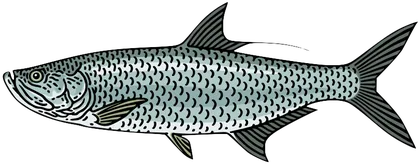
Enormous silver scales the size of coasters, a deeply upturned lower jaw, a large eye, and a long trailing filament off the back of the dorsal fin. Nothing else looks remotely like one.
Tarpon have a modified swim bladder that functions as a lung, letting them gulp air at the surface and survive in oxygen-poor water. That "rolling" behavior is how you find them.
| Scientific name | Megalops atlanticus |
|---|---|
| Family | Tarpons (Megalopidae) |
| Also known as | silver king, poon, sabalo |
| Water type | Saltwater and brackish |
| Body type (app weight estimate) | Skinny |
Where tarpon are found
Year-round in south Florida; seasonally migratory north along the Atlantic to the Carolinas and Virginia, and west along the Gulf through Alabama, Mississippi, Louisiana and Texas in summer. Juveniles live in mangrove backwaters and stagnant creeks far up into fresh water.
Commonly targeted in: Florida, Georgia, South Carolina, North Carolina, Virginia, Alabama, Mississippi, Louisiana, Texas.
Why this matters on a leaderboard. A tarpon from one end of that range and one from the other are not competing on equal footing — climate, forage and growing season all shift what a good fish looks like. That is why Fish Masters Live runs both nationwide weekly boards and custom tournaments you can lock to a state, a region, or a single body of water.
Habitat and where to look
Tarpon are found from open beaches to stagnant ditches, depending on size.
- Beaches and passes — the migratory adult fishery, especially in Florida from April through July.
- Bridges and channels — night fishing for adults on moving tides.
- Backcountry basins and mangrove creeks — juvenile tarpon from 5 to 40 pounds, catchable on light tackle year-round.
- Coastal rivers and canals — juveniles push far up into fresh and brackish water. Some of the best juvenile tarpon fishing in Florida is in water you would not look at twice.
Look for rolling fish. A tarpon gulping air at the surface is announcing exactly where it is.
Tarpon season by season
Spring
The migration begins. Tarpon move up Florida's coasts from March into May, and the Boca Grande, Homosassa and Islamorada fisheries fire up.
Sight-fishing to strings of migrating tarpon on the beaches is the signature experience of the sport, and April through June is the window.
Summer
Peak season across the whole range. Tarpon spawn offshore in early summer and are present in numbers from Texas to Virginia.
Louisiana, Alabama and Texas tarpon fishing peaks July through September. Juvenile tarpon in Florida backwaters fish well all summer on light tackle.
Fall
Tarpon move with the mullet run along Florida's east coast in September and October, and the fishing during the run can be spectacular.
By late fall the migratory fish are moving back south, and the northern Gulf and Atlantic fisheries close down.
Winter
Adult tarpon are concentrated in south Florida and the Keys. Juvenile tarpon in backcountry creeks, canals and warm-water refuges remain catchable year-round.
Cold snaps push tarpon into deep holes and warm discharges. Like snook, tarpon are cold-intolerant and severe freezes cause mortality.
Techniques and baits that work
| Technique | When and why it works |
|---|---|
| Live bait | Live crabs on an outgoing tide at a pass, or live mullet, pinfish and threadfin along beaches and bridges. The highest-percentage adult tarpon method. |
| Fly rod | An 11–12 weight with tarpon toads, cockroaches and baitfish patterns, sight-cast to rolling or laid-up fish. The purest expression of the sport. |
| Soft plastic on a jighead | For juveniles and for adults at bridges. A simple 4–5" swimbait works. |
| Dead bait on the bottom | A cut mullet or ladyfish fished on the bottom at a pass or river mouth. Standard in Texas and Louisiana. |
| Bridge fishing at night | Fish the up-current shadow line on a moving tide. Tarpon stack there and eat what the current delivers. |
Go-to baits: Live crabs · Live mullet · Cut ladyfish · Tarpon toad fly · Large soft plastic
How to measure a tarpon accurately
Adult tarpon are the one species in the app where the fish should generally not come out of the water at all.
Florida law prohibits removing tarpon over 40 inches from the water — they may not be lifted for a photo, period. That is a legal requirement, not a suggestion, and it exists because large tarpon suffer serious internal damage from being lifted.
For adults, measure alongside the boat in the water. For juveniles under 40 inches, a wet mat and a fast frame works normally.
Their tail is deeply forked — very deeply. Squaring the lobes matters more on a tarpon than on almost anything else. And their scales are huge and come off easily; a dry surface will strip them.
In the app: lay the fish flat, point your camera at it, and Fish Masters Live measures the length from the image and proposes the species automatically. You can drag the measurement box before you confirm, and every submission is reviewable — which is what makes a leaderboard built on photos actually trustworthy.
Handling and release
Tarpon are a catch-and-release fishery essentially everywhere, and Florida requires a tarpon tag even to possess one.
- Do not lift a large tarpon out of the water. In Florida this is illegal for fish over 40 inches.
- Never hold a tarpon vertically by the jaw.
- Use heavy tackle and fight the fish hard. A 45-minute fight in warm water and shark-heavy passes frequently ends with a dead tarpon, whether from exhaustion or a bull shark. Short fights are the ethical choice.
- Revive by holding the lower jaw and moving the fish forward through the water until it kicks free — a big tarpon can need ten minutes or more.
- Bow to the fish when it jumps. A tight line on a jumping tarpon breaks off or tears the hook free.
Common questions about tarpon fishing
Can you keep a tarpon in Florida?
Effectively no. Tarpon are catch-and-release only in Florida, with the sole exception of a fish pursued for an IGFA record, which requires a purchased tarpon tag. Fish over 40 inches may not be removed from the water at all — not even briefly for a photo.
When is tarpon season in Florida?
Adults migrate along the coasts from roughly April through July, with the peak in May and June around Boca Grande, Homosassa, the Keys and the east coast beaches. South Florida holds tarpon year-round, and juvenile tarpon in backcountry creeks are catchable in every month.
Why do tarpon roll at the surface?
They have a modified swim bladder that works as a primitive lung, letting them gulp atmospheric air. That lets them survive in stagnant, oxygen-poor backwaters where nothing else can live — and it makes them very easy to locate, because rolling fish announce their position.
What does 'bow to the king' mean?
When a tarpon jumps, you point the rod tip at the fish and give slack — you bow. A tight line against a hundred pounds of airborne fish either breaks the leader or levers the hook out. Bowing is the single most important skill in tarpon fishing.
Check your regulations. Seasons, size limits, slot limits and bag limits for tarpon vary by state, province and often by individual water body, and they change. Always confirm the current rules with your state or provincial fish and wildlife agency before you fish.