How to identify a snook
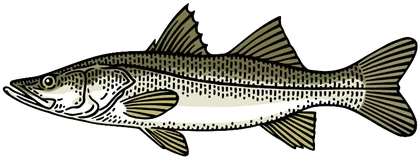
Silvery-yellow flanks, a sloping forehead, a protruding lower jaw, and a sharp, unmistakable solid black lateral line running from the gill to the tail. Nothing else in Florida inshore water has that line.
The gill plate is genuinely razor-sharp and will cut a leader instantly — and your hand nearly as fast.
| Scientific name | Centropomus undecimalis |
|---|---|
| Family | Snooks (Centropomidae) |
| Also known as | linesider, robalo, sergeant fish |
| Water type | Saltwater and brackish |
| Body type (app weight estimate) | Skinny |
Where snook are found
In the United States, snook are essentially a Florida fish. Their range runs roughly from Cape Canaveral on the Atlantic side and Tampa Bay on the Gulf side, southward through the Keys, with occasional strays into Georgia, Texas and Louisiana. They are tropical and cannot survive prolonged water below about 60 °F.
Commonly targeted in: Florida, Texas.
Why this matters on a leaderboard. A snook from one end of that range and one from the other are not competing on equal footing — climate, forage and growing season all shift what a good fish looks like. That is why Fish Masters Live runs both nationwide weekly boards and custom tournaments you can lock to a state, a region, or a single body of water.
Habitat and where to look
Structure, current and ambush points. Snook are the most structure-oriented inshore fish in Florida.
- Mangrove shorelines — the classic. Snook sit in the roots and ambush bait swept past.
- Bridges, docks and seawalls — especially at night around lights, where snook stage in the shadow line and eat anything that drifts into the light.
- Passes and inlets — moving water fisheries, and the summer spawning aggregation sites.
- Beaches — in summer, snook cruise the trough right off the sand and can be sight-fished from shore.
- Backcountry creeks and rivers — snook go far up into fresh water, especially in winter.
Snook hold on the down-current side of everything. Present the bait so it drifts naturally past the structure — a bait swimming toward a snook is usually refused.
Snook season by season
Spring
Snook move out of winter backcountry holding water toward the passes and beaches as water warms through the 70s °F. April and May are excellent transition months.
Fish spread out along shorelines and become far more accessible than in winter.
Summer
Spawning season, roughly May through September. Snook aggregate in and around passes and inlets in large numbers, and beaches fill with fish.
This is the peak of the fishery, and it is also why Florida closes snook harvest during much of the summer — the aggregations are extremely vulnerable. Catch and release fishing is generally still permitted; check current FWC dates.
Night fishing around bridge and dock lights is outstanding all summer.
Fall
The fall mullet run along Florida's east coast is one of the great events in inshore fishing. Millions of mullet move south along the beaches and every predator in the ocean follows.
September and October snook fishing on the beach and in the inlets during the run is as good as it gets anywhere.
Winter
Snook retreat to warm-water refuges — deep backcountry creeks, residential canals, power plant discharges and spring-fed rivers. They stack in these places in numbers.
Cold is the existential threat. Water below about 60 °F kills snook, and the January 2010 freeze killed an enormous number across south Florida. Fishing pressure on cold-stunned fish in refuges is an ethical problem, and Florida closes harvest in winter partly for this reason.
Techniques and baits that work
| Technique | When and why it works |
|---|---|
| Live bait free-lined | A live pilchard, threadfin, pinfish or shrimp cast up-current and allowed to drift naturally into structure. The highest-percentage snook method by far. |
| Soft plastic jerkbait | A 4–5" jerk shad on a weighted swimbait hook, worked along mangroves and dock lines. |
| Topwater walking bait | Beaches, flats and the mullet run. Snook blowups are among the most violent in inshore fishing. |
| Fly rod at dock lights | A 8–9 weight with a baitfish or shrimp pattern, cast into the shadow line and stripped into the light. Precise, visual, and addictive. |
| Bucktail jig | Bridges, passes and inlets in moving water. The traditional structure bait. |
Go-to baits: Live pilchards · Live shrimp · White jerk shad · Bucktail jig · Topwater walker
How to measure a snook accurately
Two snook-specific hazards define the measurement process:
The gill plate is a blade. Do not run your hand along it, and do not grip the fish by the gill cover. Use a lip grip or hold across the lower jaw, and support the belly.
Snook thrash violently when set down. Have the mat wet, the phone ready, and the fish landed before you plan the shot. A snook that goes airborne on a boat deck injures itself and sometimes you.
Their tail is moderately forked; square the lobes. Florida's snook slot — currently 28 to 33 inches on the Atlantic and 28 to 32 inches on the Gulf, though these change — is enforced on total length, so measure accurately before deciding anything.
In the app: lay the fish flat, point your camera at it, and Fish Masters Live measures the length from the image and proposes the species automatically. You can drag the measurement box before you confirm, and every submission is reviewable — which is what makes a leaderboard built on photos actually trustworthy.
Handling and release
Snook are strong, resilient fish that release well when handled correctly and are killed easily by a few specific mistakes.
- Support the belly. A snook held vertically by the lip, especially a big one, can suffer jaw and spinal damage.
- Never grip the gill plate.
- Use heavy leader — 30 to 50 lb fluorocarbon — not just to land fish but to shorten fights.
- Do not fish for cold-stunned snook in winter refuges. They are barely alive.
- Revive in moving water; snook after a hard fight around structure need genuine recovery time.
Florida manages snook tightly — closed seasons, a narrow slot, and one fish per person per day — because the population is climate-limited and concentrated. Know the current rules before you fish.
Common questions about snook fishing
Where can you catch snook in the United States?
Almost exclusively Florida — roughly from Cape Canaveral south on the Atlantic side and Tampa Bay south on the Gulf side, through the Keys. Snook are tropical and die in water below about 60 °F, which is what caps their northern range. Strays occasionally appear in Texas and Louisiana.
Why is snook season closed part of the year in Florida?
Two reasons. Summer closures protect spawning aggregations, when snook mass in passes and inlets and are extremely vulnerable. Winter closures protect fish concentrated in warm-water refuges during cold snaps, when they are stressed and easy to catch. Catch and release is generally still allowed — check current FWC dates and slot limits.
Why do snook cut you off so often?
Two reasons at once. Their gill plate has a genuinely razor-sharp edge that will slice monofilament in an instant, and they run straight for structure — mangrove roots, pilings, dock posts. The answer is 30 to 50 lb fluorocarbon leader and enough drag to turn the fish's head immediately.
What is the best time to catch snook?
Summer, during the spawn, when fish aggregate at passes and along beaches. The fall mullet run in September and October on Florida's east coast is the other peak. Night fishing around dock and bridge lights is excellent from spring through fall.
Check your regulations. Seasons, size limits, slot limits and bag limits for snook vary by state, province and often by individual water body, and they change. Always confirm the current rules with your state or provincial fish and wildlife agency before you fish.