How to identify a spotted seatrout
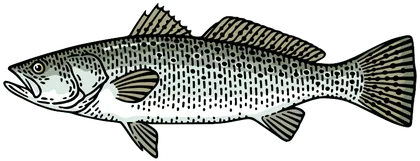
Silver-grey with a dark bluish back and distinct round black spots scattered across the upper body, the dorsal fin and the tail. Two prominent canine teeth in the upper jaw give them their other regional names.
Weakfish, the Atlantic cousin, have wavy dark markings rather than distinct round spots and are more purple-bronze. Sand seatrout are pale with no spots at all.
| Scientific name | Cynoscion nebulosus |
|---|---|
| Family | Drums and croakers (Sciaenidae) |
| Also known as | speckled trout, specks, spotted weakfish, gator trout |
| Water type | Saltwater |
| Body type (app weight estimate) | Skinny |
Where spotted seatrout are found
The Atlantic and Gulf coasts from roughly Virginia through Florida and west to Texas, with the greatest abundance from the Carolinas through Louisiana. Not a trout at all — a drum, closely related to redfish and weakfish.
Commonly targeted in: Maryland, Virginia, North Carolina, South Carolina, Georgia, Florida, Alabama, Mississippi, Louisiana, Texas, Delaware, New Jersey.
Why this matters on a leaderboard. A spotted seatrout from one end of that range and one from the other are not competing on equal footing — climate, forage and growing season all shift what a good fish looks like. That is why Fish Masters Live runs both nationwide weekly boards and custom tournaments you can lock to a state, a region, or a single body of water.
Habitat and where to look
Grass, structure and moving water.
- Seagrass flats — the classic habitat. Trout hold over grass in 2–6 feet and ambush shrimp and finger mullet.
- Deeper channels and drop-offs — where trout retreat in cold weather and in the heat of summer.
- Oyster bars and rocky points — hard structure that concentrates bait.
- Passes, jetties and bridges — moving water fisheries, particularly good at night under lights.
- Potholes — sandy bare spots inside a grass flat. Big trout sit in them and ambush anything crossing.
The largest trout — "gator trout" over about 25 inches — behave differently from schoolies: they are solitary, they hunt large mullet, and they hold in shallower water than people expect, especially at first light.
Spotted Seatrout season by season
Spring
Trout move up onto the flats as water warms through the 60s °F. This is the transition season and fishing improves steadily through March, April and May.
Spawning begins in late spring and continues into summer, with fish gathering near passes and deeper grass edges at night.
Summer
Excellent early and late; deep in the middle of the day. Topwater at dawn over grass flats is the signature summer speckled trout experience.
Through midday, fish deeper grass edges, channels and moving water. Night fishing under dock and bridge lights is outstanding all summer on the Gulf Coast.
Fall
Peak season across most of the range. Bait is thick, water is cooling, and trout feed aggressively on the flats through the middle of the day.
Fall also produces the year's best topwater fishing for large fish, especially in the Carolinas and Texas.
Winter
The trophy season. Big trout are shallow, slow, and catchable on mud bottom that absorbs heat — the backs of bays, protected canals and deep holes with dark bottom.
Fish very slowly with soft plastics and suspending twitch baits. Winter cold snaps can cause trout kills in shallow Gulf bays, and several states adjust regulations after severe freezes.
Techniques and baits that work
| Technique | When and why it works |
|---|---|
| Soft plastic on a jighead | A 3–5" shrimp or paddle-tail on a 1/8–1/4 oz head, bounced along the bottom or swum over grass. The universal speckled trout bait. |
| Popping cork with shrimp | Live or artificial shrimp suspended under a concave cork. Chugging it imitates feeding fish and calls trout from a distance. The highest-percentage numbers method on the Gulf. |
| Topwater walking bait | Over grass flats at dawn and dusk. The best big-trout artificial there is. |
| Suspending twitch bait | The winter big-trout standard. Long pauses, minimal movement, worked over mud bottom. |
| Live bait | Live shrimp, finger mullet or croaker under a cork or free-lined. Croaker in particular is a legendary — and controversial — big-trout bait in Texas. |
| Fly rod | 7–8 weight with clouser minnows and shrimp patterns on the flats. Trout eat flies readily. |
Go-to baits: Live shrimp · Soft plastic shrimp · Finger mullet · Topwater walker · Chartreuse paddle tail
How to measure a spotted seatrout accurately
Speckled trout are the most delicate inshore saltwater species and the one where handling quality most directly affects survival.
Their scales come off at the slightest contact with a dry surface. A wet mat or wet hands is not optional. A trout that loses its slime coat is very likely to die of infection days later even though it swam away fine.
Watch the canines. They are not dangerous but they will nick you, and a startled hand drops a fish.
Lay the fish flat, mouth closed, and square the tail — trout tails are moderately forked and the difference matters on a 24-inch fish, which is right around the trophy line in most states.
In the app: lay the fish flat, point your camera at it, and Fish Masters Live measures the length from the image and proposes the species automatically. You can drag the measurement box before you confirm, and every submission is reviewable — which is what makes a leaderboard built on photos actually trustworthy.
Handling and release
Speckled trout have among the highest catch-and-release mortality of common inshore species when handled carelessly, and among the lowest when handled well.
- Never hold a trout by the gills or squeeze the body.
- Use a lip grip or support under the belly with a wet hand.
- Wet everything the fish touches.
- Do not lay a trout on carpet, a dry deck, sand or a towel.
- Circle hooks with live bait cut gut-hooking dramatically.
Big trout — over 24 inches — are almost all females and carry a disproportionate share of the spawn. Several Gulf states have shifted to tighter slots specifically to protect them. Photograph them fast and put them back.
Common questions about spotted seatrout fishing
Is a speckled trout actually a trout?
No. Spotted seatrout are drums, in the family Sciaenidae with redfish, black drum and croaker. They have no relation to freshwater trout, which are salmonids. The name comes from the spotting pattern, which superficially resembles a brown trout's.
What is a gator trout?
A speckled trout over roughly 25 inches. They behave differently from schoolie trout — solitary, hunting large mullet, often in surprisingly shallow water at first light. They are almost all large females, which is why most states now protect them with tight slot limits.
What is the best time of year for big speckled trout?
Winter, in most of the range. Big trout move onto dark mud bottom in the backs of bays and protected canals where the water is warmest, and they can be sight-fished and caught on very slow presentations. It is also when the water is clearest.
Why is a popping cork so effective for speckled trout?
The chugging sound imitates trout feeding on the surface, and the cork calls fish in from well outside their sight range in stained water. It also holds the bait at a fixed depth above grass, which stops fouling. It is the single highest-percentage rig on the Gulf Coast.
Spotted Seatrout guides by region and season
Check your regulations. Seasons, size limits, slot limits and bag limits for spotted seatrout vary by state, province and often by individual water body, and they change. Always confirm the current rules with your state or provincial fish and wildlife agency before you fish.