How to identify a flounder
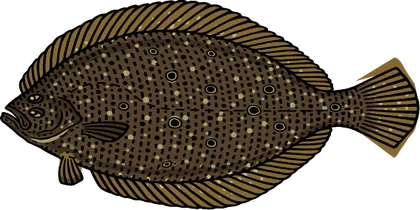
A flat, oval fish that lies on one side, with both eyes on the upward-facing side. Which side that is separates the major groups:
- Left-eyed (Paralichthys) — summer flounder (fluke) and southern flounder. Lay the fish with the belly toward you and the eyes are on the left. Large mouths full of teeth.
- Right-eyed (Pleuronectidae) — winter flounder and starry flounder. Small mouths, and much less toothy.
The upward side is mottled brown and matches the bottom the fish has been sitting on — a flounder off dark mud is nearly black, and the same fish off white sand is pale within hours. The underside is white.
| Scientific name | Paralichthys spp. / Pseudopleuronectes americanus |
|---|---|
| Family | Flatfishes (Paralichthyidae, Pleuronectidae) |
| Also known as | fluke, summer flounder, southern flounder, winter flounder, doormat |
| Water type | Saltwater |
| Body type (app weight estimate) | Skinny |
Where flounder are found
Flounder of one species or another are found on both US coasts and throughout Canada's Atlantic provinces. Summer flounder (fluke) run from Maine to North Carolina; southern flounder from the Carolinas around to Texas; winter flounder from the Canadian Maritimes to the mid-Atlantic; and starry flounder and various soles along the Pacific.
Commonly targeted in: Maine, New Hampshire, Massachusetts, Rhode Island, Connecticut, New York, New Jersey, Delaware, Maryland, Virginia, North Carolina, South Carolina, Georgia, Florida, Alabama, Mississippi, Louisiana, Texas, California, Oregon, Washington, Alaska, Nova Scotia, New Brunswick, Prince Edward Island, Newfoundland and Labrador, Quebec, British Columbia.
Why this matters on a leaderboard. A flounder from one end of that range and one from the other are not competing on equal footing — climate, forage and growing season all shift what a good fish looks like. That is why Fish Masters Live runs both nationwide weekly boards and custom tournaments you can lock to a state, a region, or a single body of water.
Habitat and where to look
Sand and mud with moving water and an ambush edge.
- Channel edges and drop-offs — flounder lie on the shallow side of a break and eat bait swept past.
- Inlet and pass mouths — the highest-density flounder water in most systems, especially on a falling tide.
- Sandy points and sloughs on beaches — surf fishing for flounder is productive and badly underused.
- Dock pilings, bridge shadows and jetty bases — anywhere current meets structure over sand.
- Backwater creeks and marsh drains — southern flounder push far back into brackish water.
They face into current and wait. Present the bait so it comes to the fish, drifting or crawling along the bottom.
Flounder season by season
Spring
Flounder move inshore from offshore wintering grounds as water warms. In the mid-Atlantic and Northeast this is the start of the fluke season, typically May.
Winter flounder in New England are a spring fishery in shallow bays and harbors on small baits.
Summer
Peak season for summer flounder and southern flounder. Fish are spread through bays, inlets and along beaches.
Drifting with bait or bucktails over sand in 10–40 feet is the standard fluke method in the Northeast. In the South, working marsh drains and creek mouths on a falling tide is the go-to.
Fall
The flounder run. As water cools, southern flounder migrate out of estuaries toward the ocean to spawn, and they funnel through inlets and passes in enormous concentrations from roughly October through December.
This is by far the best flounder fishing of the year in the Southeast and the Gulf. Several states now close the season during the run to protect spawning fish — the Carolinas and Texas in particular have made significant regulatory changes. Check current rules.
Winter
Summer flounder move offshore to the continental shelf. Winter flounder in New England become the target, taken in shallow harbors and estuaries on small hooks and worm baits.
Gulf and southeast flounder fishing is largely closed or very slow.
Techniques and baits that work
| Technique | When and why it works |
|---|---|
| Bucktail jig with a trailer | A 1/2–2 oz bucktail tipped with a strip bait or soft plastic, bounced along the bottom on a drift. The premier fluke method. |
| Live mud minnow or finger mullet | The southern flounder standard. Fished on a Carolina rig or a light jighead, crawled slowly on the bottom. |
| Drifting with a fluke rig | A two-hook rig with squid strips and spearing, drifted over sand and channel edges. |
| Gulp! soft plastics | Scented soft baits on a jighead have become the dominant flounder artificial in the last twenty years for good reason. |
| Gigging | Wading shallow flats at night with a light and a spear, where legal. A traditional and highly effective southern method, and now regulated or restricted in several states. |
Go-to baits: Live mud minnows · Finger mullet · Squid strips · White bucktail · Scented soft plastics
How to measure a flounder accurately
Flounder are the easiest fish in the app to measure and the one most affected by getting it wrong, because flounder size limits are strict and heavily enforced almost everywhere.
Lay the fish flat, eyed-side up, with the snout against the reference edge. Their body is naturally flat, so it lies perfectly — no straightening required.
The tail is squared to slightly rounded. Square it against the edge.
One species-specific caution: left-eyed flounder have serious teeth. A summer flounder or southern flounder will draw blood. Grip the fish across the body, not by the jaw.
In the app: lay the fish flat, point your camera at it, and Fish Masters Live measures the length from the image and proposes the species automatically. You can drag the measurement box before you confirm, and every submission is reviewable — which is what makes a leaderboard built on photos actually trustworthy.
Handling and release
Flounder are hardy in cool water and release reasonably well.
- Handle by the body, avoiding the mouth on toothy species.
- Use a wet hand or wet deck.
- Circle hooks with bait significantly reduce gut-hooking, which is the primary flounder release problem — they take a bait deep.
- If deeply hooked, cut the line.
Southern flounder in particular are under real management pressure across the Southeast and Gulf, with several states having sharply reduced seasons and bag limits in the last few years after stock assessments showed declines. Flounder regulations change more frequently than almost any other inshore species — verify before every trip.
Common questions about flounder fishing
What is the difference between a flounder and a fluke?
Fluke is the regional name for summer flounder (Paralichthys dentatus) used from New Jersey to New England. It is a left-eyed flounder with a large toothy mouth. Winter flounder are a different, right-eyed species with a small mouth, and southern flounder are the Gulf and Southeast equivalent of fluke.
Why do flounder have both eyes on one side?
They do not start that way. Flounder larvae are symmetrical and swim upright like any fish; during development, one eye migrates across the skull and the fish settles onto its side. It is one of the most dramatic transformations in vertebrate development.
When is the flounder run?
In the Southeast and Gulf, roughly October through December, when southern flounder leave the estuaries and funnel through inlets and passes to spawn offshore. It is the year's best flounder fishing — and because spawning fish are so concentrated and vulnerable, several states now close the season during part of it.
What is the best bait for flounder?
Live mud minnows or finger mullet crawled slowly along the bottom for southern flounder, and a bucktail jig tipped with a strip bait drifted over sand for summer flounder. Scented soft plastics have become the dominant artificial for both.
Check your regulations. Seasons, size limits, slot limits and bag limits for flounder vary by state, province and often by individual water body, and they change. Always confirm the current rules with your state or provincial fish and wildlife agency before you fish.