How to identify a smallmouth bass
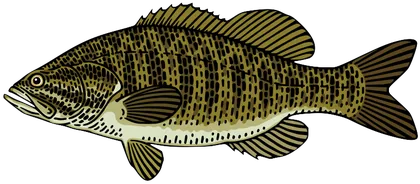
Bronze to brassy brown with dark vertical bars along the flank — the opposite orientation from a largemouth's horizontal stripe. The upper jaw stops at or before the rear of the eye. Red or amber eyes are common in adults. Three dark bars usually radiate back from the cheek.
Color varies enormously with water. A smallmouth from a clear, rocky Canadian shield lake is bright bronze; the same fish from a stained river can be nearly olive. Judge by jaw and bar orientation, not color.
| Scientific name | Micropterus dolomieu |
|---|---|
| Family | Sunfish family (Centrarchidae) |
| Also known as | bronzeback, brown bass, smallie |
| Water type | Freshwater |
| Body type (app weight estimate) | Average |
Where smallmouth bass are found
Native to the Great Lakes, Ohio and upper Mississippi basins; now established across the northern two-thirds of the US and into Ontario, Quebec and the Maritimes. Largely absent from Florida and the Gulf coastal plain, where water is too warm and too soft-bottomed.
Commonly targeted in: Alabama, Arkansas, Arizona, California, Colorado, Connecticut, Delaware, Georgia, Iowa, Idaho, Illinois, Indiana, Kansas, Kentucky, Massachusetts, Maryland, Maine, Michigan, Minnesota, Missouri, Montana, North Carolina, North Dakota, Nebraska, New Hampshire, New Jersey, New Mexico, Nevada, New York, Ohio, Oklahoma, Oregon, Pennsylvania, Rhode Island, South Carolina, South Dakota, Tennessee, Texas, Utah, Virginia, Vermont, Washington, Wisconsin, West Virginia, Wyoming, Ontario, Quebec, New Brunswick, Nova Scotia, Manitoba, British Columbia.
Why this matters on a leaderboard. A smallmouth bass from one end of that range and one from the other are not competing on equal footing — climate, forage and growing season all shift what a good fish looks like. That is why Fish Masters Live runs both nationwide weekly boards and custom tournaments you can lock to a state, a region, or a single body of water.
Habitat and where to look
Rock, current and clarity. Smallmouth relate to hard bottom the way largemouth relate to vegetation:
- Rivers — current seams, eddies behind boulders, the downstream edge of gravel bars, bridge pilings.
- Lakes — main-lake points, rock humps, boulder-strewn shorelines, gravel flats adjacent to deep water.
- Great Lakes — offshore reefs and shoals, often in 15–35 feet, where they feed on gobies and emerald shiners.
They need cooler water than largemouth. Their preferred band is roughly 65–72 °F, and they will pull deep or move into current to find it in midsummer.
Smallmouth Bass season by season
Spring
As water passes the low 50s °F, smallmouth stage on the deep edge of gravel flats and eat a suspending jerkbait better than any other bait in existence. This is the classic pre-spawn pattern in the Great Lakes and northern reservoirs, and it produces the biggest fish of the year.
Spawning happens around 60–65 °F on sand and gravel in 2–8 feet, usually next to a boulder or a log the male can guard against. Many northern states and provinces close or restrict smallmouth season during the spawn — check regulations before you go.
Summer
In rivers, smallmouth spread through the entire system and hold in current seams all day. Topwater at dawn, then tube jigs, Ned rigs and small crankbaits through the middle.
In lakes they group on offshore rock — reefs, humps, points in 15–30 feet. A drop-shot with a 3–4" minnow bait and a football-head jig are the two workhorses. On the Great Lakes, a goby-imitating tube on hard bottom is close to a cheat code.
Fall
The best smallmouth month of the year in most of the country. Fish feed heavily and pull onto steep transitions adjacent to their wintering water. Blade baits, jerkbaits, hair jigs and swimbaits all shine.
River fish begin migrating out of shallow summer haunts toward deep wintering holes — often the deepest pools in a several-mile stretch. Find those pools in the fall and you have found next winter's fish too.
Winter
Smallmouth become extremely lethargic below about 45 °F but do not stop eating. In rivers they stack in deep slow pools in numbers that seem impossible; a hair jig or blade bait fished agonizingly slowly on the bottom is the standard.
In the North, ice fishing over deep rock with a small jigging spoon takes them, though many jurisdictions protect smallmouth in winter. Again — check the regulations.
Techniques and baits that work
| Technique | When and why it works |
|---|---|
| Tube jig | The definitive smallmouth bait. 3.5–4" tube on a 1/8–3/8 oz internal head, dragged and hopped on rock. Imitates crayfish and gobies equally well. |
| Ned rig | A short stick-bait on a 1/16–1/4 oz mushroom head. Almost unfair on pressured fish and in cold water. |
| Suspending jerkbait | Pre-spawn and fall in clear water. Cadence matters more than the bait: two hard jerks, then a pause of three to ten seconds. |
| Drop-shot | For offshore fish you can see on electronics. 6–8 lb fluorocarbon leader, 12–18" tag, small minnow-profile plastic. |
| Topwater walking bait | Dawn and dusk over shallow rock, and all day in a chop. Smallmouth will come up from 20 feet to eat one. |
| Hair jig | Cold-water river fishing. 1/8–3/8 oz, marabou or bucktail, dead-drifted through deep pools. |
Go-to baits: Green pumpkin tube · Goby-pattern jig · Ghost-shad jerkbait · Crayfish-pattern crankbait · Natural-hue Ned rig
How to measure a smallmouth bass accurately
Smallmouth have a stiffer, more muscular body than largemouth and tend to flex hard when you set them down. Wet your hand and the mat first — a dry surface makes them thrash.
Their tail is deeply forked, so squeezing the lobes together matters more here than on any other black bass. The difference between fork length and pinched total length on a 19-inch smallmouth can be nearly an inch, which is often the difference between first and third on a weekly leaderboard.
Because their flanks are reflective bronze, direct midday sun can blow out the image and confuse automatic species detection. Shade the fish with your body or shoot from a slight angle.
In the app: lay the fish flat, point your camera at it, and Fish Masters Live measures the length from the image and proposes the species automatically. You can drag the measurement box before you confirm, and every submission is reviewable — which is what makes a leaderboard built on photos actually trustworthy.
Handling and release
Smallmouth are more fragile than largemouth in warm water. Above about 78 °F, delayed mortality climbs sharply — keep them out of the water under 20 seconds and skip the extended photo session.
Support the belly on any fish over 15 inches. In current, revive the fish facing upstream until it kicks away on its own rather than dropping it and hoping. Deep-caught Great Lakes fish frequently need venting; if the fish will not stay upright, do not just release it and leave.
Common questions about smallmouth bass fishing
Where can you not catch smallmouth bass?
Peninsular Florida and most of the Gulf coastal plain have no meaningful smallmouth population — the water is too warm and the bottom too soft. Louisiana, Mississippi and coastal Texas are effectively largemouth country. Smallmouth do exist in the cool tailwaters and highland reservoirs of northern Alabama, Georgia, Tennessee and Arkansas.
What water temperature do smallmouth bass prefer?
Roughly 65 to 72 °F. They stay active from the high 40s through the low 80s, but their feeding peak sits in that band, which is why they push deep or into current when a lake's surface climbs into the mid-80s.
Why do smallmouth fight harder than largemouth?
Body composition and habitat. Smallmouth carry proportionally more red muscle, and they live in current and cool oxygen-rich water, which supports sustained aerobic effort. A largemouth makes one or two violent surges; a smallmouth runs, jumps, and keeps going.
What is the best all-around smallmouth bait?
A tube jig. It imitates a crayfish on the drag, a goby on the hop, and a fleeing baitfish on the swim, and it fishes rock without constantly snagging. If you carry one smallmouth bait, carry green pumpkin tubes in 3.5 inches.
Smallmouth Bass guides by region and season
Check your regulations. Seasons, size limits, slot limits and bag limits for smallmouth bass vary by state, province and often by individual water body, and they change. Always confirm the current rules with your state or provincial fish and wildlife agency before you fish.