How to identify a walleye
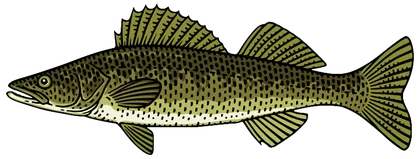
Olive to golden-brown with a brassy sheen, a long cylindrical body, two separate dorsal fins, and prominent canine teeth. Two marks are definitive: a large opaque, reflective eye (the tapetum lucidum that gives them night vision and their name), and a distinct white tip on the lower lobe of the tail.
Sauger, their close relative, have distinct black spots on the spiny dorsal fin and lack the white tail tip. Saugeye — the hybrid — show a mix of both.
| Scientific name | Sander vitreus |
|---|---|
| Family | Perches (Percidae) |
| Also known as | walleyed pike, marble eyes, pickerel (Canada) |
| Water type | Freshwater |
| Body type (app weight estimate) | Average |
Where walleye are found
Native across the Great Lakes basin, the upper Mississippi drainage and most of Canada, and introduced from the Dakotas through the Rockies and into the Southeast. In Canada, walleye are commonly called pickerel — which is confusing, because in the US a pickerel is a small pike.
Commonly targeted in: Alabama, Arkansas, Colorado, Connecticut, Georgia, Iowa, Idaho, Illinois, Indiana, Kansas, Kentucky, Massachusetts, Maryland, Maine, Michigan, Minnesota, Missouri, Montana, North Carolina, North Dakota, Nebraska, New Hampshire, New Jersey, New Mexico, Nevada, New York, Ohio, Oklahoma, Oregon, Pennsylvania, Rhode Island, South Carolina, South Dakota, Tennessee, Texas, Utah, Virginia, Vermont, Washington, Wisconsin, West Virginia, Wyoming, Arizona, Alberta, British Columbia, Manitoba, New Brunswick, Northwest Territories, Ontario, Quebec, Saskatchewan, Yukon, Nova Scotia.
Why this matters on a leaderboard. A walleye from one end of that range and one from the other are not competing on equal footing — climate, forage and growing season all shift what a good fish looks like. That is why Fish Masters Live runs both nationwide weekly boards and custom tournaments you can lock to a state, a region, or a single body of water.
Habitat and where to look
Walleye relate to bottom, structure and light levels.
- Rock and gravel — main-lake points, reefs, rip-rap and shoreline breaks.
- Sand and mud flats — especially where they meet a weed edge or a break.
- River current — wing dams, current seams, and below dams.
- Deep basin — in summer, walleye in big lakes suspend over open water chasing pelagic bait.
Wind is a genuine walleye variable. A shoreline the wind has been blowing into for hours — the "walleye chop" — pushes plankton, then bait, then walleye into the shallows.
Walleye season by season
Spring
The spawning run. As water reaches roughly 42–50 °F, walleye move into rivers and onto shallow rocky shorelines and reefs to spawn at night.
Post-spawn, fish stage on the first breaks outside spawning areas. Jigs tipped with minnows fished slowly are the classic approach. Many states restrict or close walleye season during the spawn — check dates carefully.
Summer
Walleye spread out. Weed edges, deep structure, and open-water suspension all hold fish depending on the lake.
Trolling crankbaits and spinner-and-crawler harnesses covers water and finds them. Bottom bouncers with harnesses along breaks is the most universally effective summer method in the Midwest.
Fall
The trophy season. Big female walleye feed heavily and move to shallow rock and river mouths, especially at night.
Casting stickbaits over shallow rock after dark from October into December is how a large share of genuine trophy walleye are caught, and almost nobody does it.
Winter
A premier ice-fishing target. Walleye feed in low light — the first and last hour of daylight are dramatically better than midday.
Jigging spoons, rattle baits and jigging minnows near bottom, with a dead-stick tipped with a live minnow beside you, is the standard setup.
Techniques and baits that work
| Technique | When and why it works |
|---|---|
| Jig and minnow | A 1/8–3/8 oz jig tipped with a fathead or shiner, dragged slowly on bottom. The most reliable walleye presentation in existence. |
| Bottom bouncer and spinner harness | Trolled slowly along breaks and flats with a nightcrawler. The Midwest summer standard. |
| Trolling crankbaits | For open-water and suspended fish. Lead core, planer boards, and precise depth control. |
| Slip bobber and leech | For fish holding tight to a specific rock or hump. Deadly and easy to fish accurately. |
| Night casting stickbaits | Shallow rock after dark in fall and spring. The trophy method. |
| Jigging spoon (ice) | 1/8–1/2 oz spoon tipped with a minnow head, worked aggressively then held still. |
Go-to baits: Fathead minnows · Leeches · Nightcrawlers · 1/4 oz jig · Shad-pattern crankbait
How to measure a walleye accurately
Walleye have sharp teeth and razor-edged gill plates — a badly handled walleye will cut you, and a badly handled walleye also usually gets a bad measurement because you are rushing.
Grip across the top of the head behind the eyes, or use a lip grip. Do not slide your hand under the gill plate.
Lay the fish flat with the mouth closed. Their tail is moderately forked with that distinctive white lower tip; pinch the lobes together. Straighten the body fully — walleye are long and will curve.
Many states have protected slot limits on walleye enforced on total length, so an accurate measurement is a legal matter, not just a leaderboard one.
In the app: lay the fish flat, point your camera at it, and Fish Masters Live measures the length from the image and proposes the species automatically. You can drag the measurement box before you confirm, and every submission is reviewable — which is what makes a leaderboard built on photos actually trustworthy.
Handling and release
Walleye release reasonably well from shallow water and poorly from deep water.
- Barotrauma is the main issue. Walleye caught deeper than about 30 feet frequently cannot descend. If you are fishing deep and intend to release, reconsider — or plan to keep your limit and stop.
- Support the belly on large females, which are the most valuable fish in any walleye population.
- Handle with wet hands and mind the teeth and gill plates.
- In summer, warm surface water plus a long fight raises delayed mortality significantly.
Common questions about walleye fishing
What is the best time of day to catch walleye?
Dawn, dusk and after dark. Walleye have a reflective layer behind the retina that gives them a large advantage over prey in dim light, so they feed hardest when it is too dark for baitfish to see well. Overcast and windy days extend that window through the middle of the day.
What is the difference between a walleye and a sauger?
A walleye has a white tip on the lower lobe of its tail and a clear spiny dorsal fin. A sauger has distinct black spots on the spiny dorsal and no white tail tip, and is generally smaller and more river-oriented. Saugeye — the hybrid — show intermediate traits.
Why is walleye called pickerel in Canada?
It is a long-standing regional name, particularly in Ontario, Manitoba and Saskatchewan. It causes real confusion because in the United States, pickerel refers to chain and grass pickerel, which are small members of the pike family and a completely different fish.
How deep should I fish for walleye?
It depends on light and season. In low light and cold water, walleye are frequently in under 15 feet on rock. In bright midsummer conditions they may hold 20 to 35 feet on structure or suspend over open water. Start on the break between shallow and deep and work outward.
Walleye guides by region and season
Spring Walleye Fishing in Iowa: The Mississippi, the Iowa Great Lakes and the Reservoirs
Iowa's walleye season opens with the Mississippi River tailwaters in March and rolls into the Iowa Great Lakes and the interior reservoirs by May.…
Ice Fishing for Walleye in Minnesota: Lakes, Timing and Tactics
A practical guide to Minnesota's hard-water walleye season — Lake of the Woods, Upper Red, Mille Lacs, Leech, Winnibigoshish and Rainy — including…
Check your regulations. Seasons, size limits, slot limits and bag limits for walleye vary by state, province and often by individual water body, and they change. Always confirm the current rules with your state or provincial fish and wildlife agency before you fish.