How to identify a bonefish
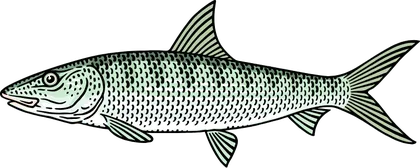
Bright chrome-silver, torpedo-shaped, with a conical snout and a distinctly inferior (downward-facing) mouth built for rooting in sand. Faint dark bars are sometimes visible on the back. The tail is deeply forked.
Their reflectivity is the whole problem: a bonefish on a sand flat is a mirror, and you will usually see its shadow or its tail before you see the fish.
| Scientific name | Albula vulpes |
|---|---|
| Family | Bonefishes (Albulidae) |
| Also known as | grey ghost, banana fish, macabi |
| Water type | Saltwater |
| Body type (app weight estimate) | Skinny |
Where bonefish are found
In the United States, bonefish are confined to south Florida — Biscayne Bay, the Florida Keys, and the flats of Florida Bay — plus Hawaii, where a separate species is present. They are otherwise a Caribbean, Bahamian and Indo-Pacific fish.
Commonly targeted in: Florida, Hawaii.
Why this matters on a leaderboard. A bonefish from one end of that range and one from the other are not competing on equal footing — climate, forage and growing season all shift what a good fish looks like. That is why Fish Masters Live runs both nationwide weekly boards and custom tournaments you can lock to a state, a region, or a single body of water.
Habitat and where to look
Shallow tropical flats — sand, marl, turtle grass and coral rubble — usually in 6 inches to 4 feet of water.
- Sand and marl flats — the classic. Bonefish move onto them on a rising tide to feed on crabs, shrimp and worms.
- Mangrove edges — cover adjacent to feeding flats, where fish stage on low water.
- Channels and cuts between flats — travel routes. Ambush points on a moving tide.
- Deeper "muds" — schools of bonefish stirring up bottom in slightly deeper water, visible as a pale cloud.
Everything about bonefishing is tide-driven. Fish push onto a flat with the flood and off it with the ebb, and being on the right flat at the right stage is most of the game.
Bonefish season by season
Spring
Excellent. Water warms, fish are active on the flats, and spring in the Keys and Biscayne Bay is one of the two best windows of the year.
March through May is peak, with settled weather and good tides.
Summer
Good early and late, hot in the middle. Bonefish tolerate warm water but will move off the shallowest flats when they get too hot.
Summer afternoons on a dark marl flat can be excellent because the fish are less pressured, and the water is often calm enough for easy spotting.
Fall
The second peak. September through November brings settled weather, warm water and good numbers before the winter cold fronts start.
Fall in the Keys is arguably the best combination of fish activity and comfortable conditions of the year.
Winter
Cold fronts are the enemy. A north wind that drops flat temperatures pushes bonefish off the shallows into deeper channels and basins, sometimes for days.
Between fronts, winter fishing is very good — water is clear, fish are visible, and the flats are quiet. It is a fishery of narrow windows.
Techniques and baits that work
| Technique | When and why it works |
|---|---|
| Fly rod sight fishing | An 8-weight, a 12-foot leader, and a small weighted crab or shrimp pattern led ahead of a moving fish. The defining method of the sport. |
| Live shrimp on a light jighead | The most effective spin-tackle method. Cast well ahead of the fish and let it settle. |
| Small soft plastics | A 1/8 oz jig with a small shrimp imitation, worked with short hops on sand. |
| Chumming | Where legal, a small amount of cut shrimp on a flat can hold fish in an area and is a common Bahamian and Keys technique. |
Go-to baits: Live shrimp · Gotcha fly · Crab patterns · Small shrimp jig
How to measure a bonefish accurately
Bonefish are among the most fragile fish in the app and — crucially — they are hunted by sharks and barracuda on every flat they live on. A poorly handled bonefish is very often eaten within a minute of release.
Measure the fish in the water. Keep it submerged, use a shallow-water measuring approach, and lift only briefly if at all.
Their tail is deeply forked, so squaring the lobes matters. Their body is firm and straight, so they lie well and measure consistently.
Never lay a bonefish on hot sand, a hot boat deck, or coral. Never.
In the app: lay the fish flat, point your camera at it, and Fish Masters Live measures the length from the image and proposes the species automatically. You can drag the measurement box before you confirm, and every submission is reviewable — which is what makes a leaderboard built on photos actually trustworthy.
Handling and release
Bonefish handling is the strictest of any species here, and the reason is predation, not fragility alone.
- Keep the fish in the water. Full stop, whenever possible.
- Fight it as fast as the tackle allows. A long fight means an exhausted fish that cannot escape a shark.
- Revive fully. Hold the fish upright, facing into current, and do not let go until it drives out of your hands.
- If sharks are working the flat, either move or do not fish there.
- Barbless hooks, wet hands, no gloves.
Bonefish are entirely catch-and-release in Florida — it is illegal to harvest one — and the fishery in Biscayne Bay and the Keys has been under real strain for two decades.
Common questions about bonefish fishing
Where can you catch bonefish in the United States?
South Florida only — Biscayne Bay, the Florida Keys and Florida Bay — plus Hawaii, which holds a related species. Everywhere else in the US is outside their range.
Why are bonefish so hard to see?
Their flanks are near-perfect mirrors that reflect the sand and water around them. Experienced flats anglers look for the shadow on the bottom, the wake, a tail breaking the surface, or the puff of mud from a feeding fish — not for the fish itself.
Can you keep bonefish in Florida?
No. Bonefish are catch-and-release only in Florida and have been designated a restricted species for years. The Biscayne Bay and Keys populations have declined significantly and the fishery is managed conservatively.
What tide is best for bonefish?
The first two to three hours of a rising tide onto a flat, when fish push shallow to feed, and the last of the falling tide as they funnel off through cuts and channels. Slack high water spreads fish out and makes them much harder to find.
Check your regulations. Seasons, size limits, slot limits and bag limits for bonefish vary by state, province and often by individual water body, and they change. Always confirm the current rules with your state or provincial fish and wildlife agency before you fish.