How to identify a steelhead
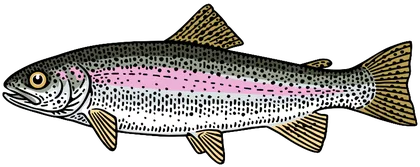
Chrome-bright silver flanks, a dark steel-blue back, and a faint or absent pink lateral band on fresh fish. Heavy black spotting across the back and tail — the radiating spots on the tail are the reliable separation from a lake-run brown trout, whose tail is clean.
Fish that have been in the river for weeks color up: the pink band returns, the back darkens, and males develop a kype. A "chrome" fish is fresh from the lake or ocean; a "colored" fish has been in the river a while.
| Scientific name | Oncorhynchus mykiss (anadromous form) |
|---|---|
| Family | Salmonids (Salmonidae) |
| Also known as | steelie, chromer, sea-run rainbow |
| Water type | Freshwater and saltwater |
| Body type (app weight estimate) | Skinny |
Where steelhead are found
Native to Pacific drainages from Alaska through California. Introduced and self-sustaining in the Great Lakes, where tributaries in Michigan, Ohio, Pennsylvania, New York, Wisconsin, Indiana and Ontario support a major fishery.
Commonly targeted in: Alaska, Washington, Oregon, California, Idaho, Michigan, Ohio, Pennsylvania, New York, Wisconsin, Indiana, Illinois, Minnesota, British Columbia, Ontario, Yukon.
Why this matters on a leaderboard. A steelhead from one end of that range and one from the other are not competing on equal footing — climate, forage and growing season all shift what a good fish looks like. That is why Fish Masters Live runs both nationwide weekly boards and custom tournaments you can lock to a state, a region, or a single body of water.
Habitat and where to look
Rivers, on a schedule. Steelhead are travelers, and finding them is about understanding where migrating fish rest and where they hold.
- Tailouts — the flat slick at the bottom of a pool where it accelerates into the next riffle. The classic steelhead lie.
- Seams — the boundary between fast and slow water alongside a heavy run.
- Deep slots and pool heads — cold-weather holding water.
- Below barriers — dams, falls, and log jams stack fish.
Water clarity drives everything. Two feet of visibility is close to ideal: enough that fish can see the presentation, dirty enough that they lose their caution.
Steelhead season by season
Spring
Spring-run fish and the tail of the winter run. Great Lakes tributaries fish very well in March and April as steelhead move up to spawn, and water is high and cold.
This is when most Great Lakes steelhead are caught. Egg patterns, beads and jigs under a float account for the majority.
Summer
On the West Coast, summer-run steelhead enter rivers from May through September and are the fish that made swung-fly steelheading famous. They hold for months before spawning and will move to a waking dry fly in low water.
Great Lakes tributaries are mostly too low and warm in summer; the exception is a few cold spring-fed systems and the Skamania strain, which runs in summer.
Fall
Great Lakes tributaries begin filling in October and November as water cools and rain raises the rivers. Fresh chrome fish, aggressive and strong.
Fall is arguably the best time to be on a Great Lakes steelhead river: fish are fresh, water is cold but not frozen, and the crowds are lighter than in spring.
Winter
Winter-run steelhead on the West Coast — December through March — are the largest and most celebrated. Cold water, heavy flows, and low numbers.
Great Lakes rivers fish through winter wherever there is open water. Fish get sluggish and sit in the deepest slowest water available. Small presentations, dead slow, right on the bottom.
Techniques and baits that work
| Technique | When and why it works |
|---|---|
| Float fishing (centerpin or spinning) | A jig, bead or bait suspended under a float and drifted at current speed. The highest-percentage method on Great Lakes tributaries by a wide margin. |
| Swinging flies | A two-handed rod, a sink tip, and a wet fly swung across the current. Low hookup rate, high devotion rate. The traditional West Coast method. |
| Nymphing under an indicator | Egg patterns, stoneflies and small nymphs dead-drifted through tailouts and slots. |
| Drift fishing | Bait or a yarn ball bounced along the bottom with just enough weight to tick. The original steelhead method and still deadly. |
| Casting spoons and spinners | Underrated. A 1/4–3/8 oz spinner worked slowly through a run takes aggressive fish, especially in colored water. |
Go-to baits: Spawn sacs · Trout beads · Pink marabou jig · Egg-sucking leech · Blue Fox spinner
How to measure a steelhead accurately
Steelhead are long, powerful, and usually caught while you are standing in cold moving water — the hardest measuring conditions in the app.
Never lift a steelhead onto a gravel bar. Keep it in the net, in the water, and measure it in shallow water at the bank if the rules allow, or on a wet mat for the few seconds it takes.
Their tail is squarish with a slight fork; square the lobes for a consistent number. Straighten the body fully — a big steelhead curls hard and will read short.
Cold hands make for slow work. Set the phone up before you land the fish, not after.
In the app: lay the fish flat, point your camera at it, and Fish Masters Live measures the length from the image and proposes the species automatically. You can drag the measurement box before you confirm, and every submission is reviewable — which is what makes a leaderboard built on photos actually trustworthy.
Handling and release
Wild steelhead populations on the West Coast are in serious decline, and many runs are protected — in a number of rivers, wild fish must be released unharmed and cannot leave the water at all.
- Know whether the fish is wild or hatchery. A clipped adipose fin means hatchery; an intact adipose means wild.
- Keep wild fish in the water. Full stop, in many jurisdictions.
- Barbless hooks are required in many steelhead waters.
- Never beach a steelhead on gravel.
Great Lakes steelhead are hatchery-supported and rules are generally less restrictive, but the handling principles are identical.
Common questions about steelhead fishing
What is the difference between steelhead and rainbow trout?
They are one species, Oncorhynchus mykiss. Steelhead are the migratory form: they go to the ocean or a Great Lake, grow much larger on rich forage, and return to freshwater to spawn. Resident rainbows stay in the river their whole lives and stay smaller.
When is the best time to catch steelhead?
On Great Lakes tributaries, late October through April, with fall and early spring the peak. On the West Coast, winter-run fish arrive December through March and summer-run fish May through September, varying by river.
What water conditions are best for steelhead?
A dropping river with about two feet of visibility, a day or two after a rain. Too clear and fish are spooky; too dirty and they cannot find the presentation. Water temperature in the high 30s to high 40s Fahrenheit is prime.
Do steelhead die after spawning?
No — unlike Pacific salmon, steelhead can survive spawning and return to the ocean or lake to spawn again. Repeat spawners are relatively rare, which makes them disproportionately valuable to a run.
Steelhead guides by region and season
Check your regulations. Seasons, size limits, slot limits and bag limits for steelhead vary by state, province and often by individual water body, and they change. Always confirm the current rules with your state or provincial fish and wildlife agency before you fish.