How to identify a lake trout
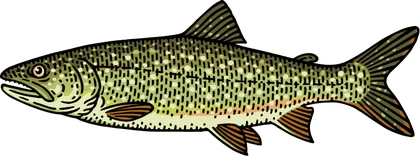
Grey to greenish-grey with irregular pale cream spots covering the body, head and fins — light spots on a dark body, the char signature. The tail is deeply forked, which separates lake trout from every other char at a glance. Brook trout have a square tail; Arctic char a shallow fork; lake trout a deep one.
The flesh ranges from white to deep orange depending on diet. Coloration varies widely between populations — Great Lakes "leans" and deep-water "siscowets" look quite different.
| Scientific name | Salvelinus namaycush |
|---|---|
| Family | Salmonids (Salmonidae) — char |
| Also known as | laker, togue, mackinaw, grey trout |
| Water type | Freshwater |
| Body type (app weight estimate) | Average |
Where lake trout are found
Native across Canada and the northern US — the Great Lakes, New England, the Adirondacks, Alaska, and virtually every deep cold lake north of the last glaciation. Introduced into deep western reservoirs from Montana to Nevada.
Commonly targeted in: Alaska, Maine, New Hampshire, Vermont, New York, Michigan, Minnesota, Wisconsin, Montana, Idaho, Wyoming, Colorado, Utah, Nevada, Washington, Oregon, California, Pennsylvania, Connecticut, Massachusetts, Alberta, British Columbia, Manitoba, New Brunswick, Newfoundland and Labrador, Nova Scotia, Northwest Territories, Nunavut, Ontario, Quebec, Saskatchewan, Yukon.
Why this matters on a leaderboard. A lake trout from one end of that range and one from the other are not competing on equal footing — climate, forage and growing season all shift what a good fish looks like. That is why Fish Masters Live runs both nationwide weekly boards and custom tournaments you can lock to a state, a region, or a single body of water.
Habitat and where to look
Deep, cold, oxygen-rich lakes. Lake trout require water below about 55 °F and will hold in it wherever it is:
- Spring and late fall — shallow, sometimes in under 20 feet, right after ice-out and again before ice-in. The entire lake is cold, so they can be anywhere.
- Summer — deep, often 60 to 150 feet, pinned below the thermocline. This is when they are hardest to reach and easiest to kill on release.
- Structure — main-lake humps, sharp-breaking points, rock reefs, and the deepest basin.
In far northern lakes with no thermocline, lake trout stay shallow and catchable all summer, which is why fly-out trips to the Northwest Territories and Nunavut are so productive.
Lake Trout season by season
Spring
Ice-out is the single best window of the year. Lake trout come shallow to feed and can be caught casting spoons and swimbaits from shore or trolling in 10–30 feet. In Maine, Vermont and Ontario, the ice-out laker bite is a well-known tradition.
This is also the only time most anglers can reasonably target them without downriggers.
Summer
Deep water and specialized gear. Downriggers, lead core, or heavy vertical jigging over 80–150 feet.
Summer is the highest-risk season for release mortality by a wide margin. A lake trout brought up from 100 feet has severe barotrauma and, in most cases, will not survive release regardless of technique. If you are fishing deep in summer, plan to keep your legal limit and stop.
Fall
Lake trout spawn in fall on shallow rocky reefs and shoals, usually at night, in water often under 20 feet. Fish move up and become accessible again.
Many jurisdictions close lake trout season in fall to protect spawners. Where it is open, the fishing can be outstanding — and the fish are extremely vulnerable, so read the rules carefully.
Winter
A premier ice-fishing species across Canada, New England, the Great Lakes and the Rockies. Jigging large spoons, tube jigs and airplane jigs over deep structure, or set lines with big live or dead bait.
Winter lake trout are shallow-ish by their standards — 30 to 80 feet is typical — and release survival is far better than in summer.
Techniques and baits that work
| Technique | When and why it works |
|---|---|
| Vertical jigging | A 3/4–2 oz tube jig, spoon or airplane jig dropped to bottom and ripped upward. The most engaging way to catch them and the best method through ice. |
| Downrigger trolling | Summer standard. Spoons and body baits at 1.8–2.5 mph, presented within a few feet of the fish's depth. |
| Casting spoons at ice-out | 1/2–1 oz casting spoons from shore or a boat in 10–30 feet in the weeks after the ice goes. |
| Lead core / copper line | Trolling without downriggers. Each color of lead core sinks roughly five feet at trolling speed. |
| Dead-bait set lines | A whole cisco or smelt on the bottom through the ice. Passive but extremely effective on large fish. |
Go-to baits: White tube jig · Silver jigging spoon · Cisco or smelt · Flutter spoon · Large swimbait
How to measure a lake trout accurately
Lake trout are the largest freshwater species most Fish Masters Live anglers will submit, and long fish are the ones people most often measure wrong.
Lay the fish out completely straight — a 36-inch laker that curves even slightly will read two inches short. Two people make this far easier than one.
Their tail is deeply forked, so pinching the lobes is essential. The difference between fork and pinched total length on a big laker can exceed two inches.
Do not lift a large lake trout vertically. Support it horizontally under the pectorals and the vent, get the frame, and get it back.
In the app: lay the fish flat, point your camera at it, and Fish Masters Live measures the length from the image and proposes the species automatically. You can drag the measurement box before you confirm, and every submission is reviewable — which is what makes a leaderboard built on photos actually trustworthy.
Handling and release
Depth is the deciding factor for lake trout survival.
Under about 30 feet: release survival is good with normal careful handling.
Over about 60 feet in summer: survival is poor and often near zero. The swim bladder over-expands on the way up and the damage is usually fatal even if the fish swims off. If you intend to release, fish shallow water — ice-out, fall, or through the ice — and leave the summer deep fishery to anglers who are harvesting.
Lake trout are also extremely slow-growing. A 35-inch fish in a northern lake may be 25 years old and irreplaceable on any human timescale.
Common questions about lake trout fishing
How deep do you fish for lake trout?
It depends entirely on season. At ice-out and again in late fall they can be in 10 to 30 feet. Through summer they sit below the thermocline, commonly 60 to 150 feet. Through the ice, 30 to 80 feet is typical.
Are lake trout hard to catch?
Not once you find them — they are aggressive and will chase a jig hard. The difficulty is entirely locating cold water and structure, which usually means electronics and depth control. At ice-out they are as easy as any fish in the lake.
How old do lake trout get?
Very old. Fish over 40 years are documented, and in far northern lakes some individuals exceed 50. That extreme longevity and slow growth is why lake trout populations collapse easily and recover slowly.
What is the difference between a lake trout and an Arctic char?
Both are char. Lake trout are grey with cream spots and a deeply forked tail. Arctic char have pink to red spots, often brilliant orange or red bellies in spawning condition, and only a shallow tail fork.
Check your regulations. Seasons, size limits, slot limits and bag limits for lake trout vary by state, province and often by individual water body, and they change. Always confirm the current rules with your state or provincial fish and wildlife agency before you fish.