How to identify a common carp
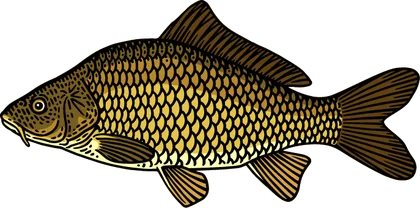
Heavy, deep-bodied and brassy-gold with large scales, a long single dorsal fin with a serrated leading spine, and — the giveaway — two pairs of barbels at the corners of the mouth. The mouth is downturned and protrusible, built for vacuuming bottom.
Mirror carp are the same species with large irregular scattered scales; leather carp are nearly scaleless. Grass carp are longer and more torpedo-shaped with no barbels. Buffalo and suckers, which people frequently confuse with carp, have no barbels at all.
| Scientific name | Cyprinus carpio |
|---|---|
| Family | Minnows and carps (Cyprinidae) |
| Also known as | carp, golden bones, mud marlin |
| Water type | Freshwater |
| Body type (app weight estimate) | Chunky |
Where common carp are found
Introduced from Eurasia in the 1800s and now present in all 48 contiguous states and southern Canada. Carp live in water that supports nothing else — urban rivers, warm shallow lakes, drainage canals — which makes them the most universally accessible large gamefish in North America.
Commonly targeted in: Alabama, Arkansas, Arizona, California, Colorado, Connecticut, Delaware, Florida, Georgia, Iowa, Idaho, Illinois, Indiana, Kansas, Kentucky, Louisiana, Massachusetts, Maryland, Maine, Michigan, Minnesota, Missouri, Mississippi, Montana, North Carolina, North Dakota, Nebraska, New Hampshire, New Jersey, New Mexico, Nevada, New York, Ohio, Oklahoma, Oregon, Pennsylvania, Rhode Island, South Carolina, South Dakota, Tennessee, Texas, Utah, Virginia, Vermont, Washington, Wisconsin, West Virginia, Wyoming, Ontario, Quebec, Manitoba, Saskatchewan, Alberta, British Columbia, New Brunswick, Nova Scotia.
Why this matters on a leaderboard. A common carp from one end of that range and one from the other are not competing on equal footing — climate, forage and growing season all shift what a good fish looks like. That is why Fish Masters Live runs both nationwide weekly boards and custom tournaments you can lock to a state, a region, or a single body of water.
Habitat and where to look
Almost anywhere warm and productive.
- Shallow silt and mud flats — carp root through bottom sediment for insect larvae, and their feeding leaves clouds of mud and bubbles you can spot from a distance.
- Urban rivers and canals — some of the best carp fishing in the country runs through cities.
- Warm shallow lake bays — especially in spring.
- Below dams and in current seams — river carp stack in predictable spots.
Carp are visible fish. In clear water they can be sight-fished on flats exactly like bonefish, which is why fly anglers have taken to them so seriously in the last twenty years.
Common Carp season by season
Spring
Carp move into shallow warm bays and backwaters as water climbs through the 60s °F, and spawn noisily in vegetation at roughly 65–75 °F — thrashing, splashing and completely uninterested in your bait while it happens.
Pre-spawn and post-spawn feeding is intense. Spring is the best sight-fishing season on flats.
Summer
Prime season. Carp feed actively all summer in warm water that shuts down most other species, which makes them the perfect August target.
Bank fishing with a hair-rigged bait and a bite alarm, or stalking flats with a fly rod. Early morning and evening are best, but carp will feed all day.
Fall
Carp feed heavily to build fat reserves before winter, and fall produces some of the largest fish of the year. Water clears in many systems, which improves sight fishing.
Winter
Carp become largely dormant below about 50 °F but do not stop feeding entirely. In the South and in warmer tailwaters they remain catchable year-round on slowly presented baits. In the North they are effectively out of season.
Techniques and baits that work
| Technique | When and why it works |
|---|---|
| Hair rig with boilies or corn | The European method that transformed carp fishing: the bait sits on a short hair beside the hook rather than on it, so the fish takes the bait and hooks itself. Fished on a bolt rig with a heavy lead. |
| Pre-baiting / chumming | Where legal, putting sweet corn or a groundbait mix on a spot for a day or two before you fish it is the single highest-leverage carp tactic there is. |
| Fly fishing on flats | Sight-cast a small crayfish, hellgrammite or bread pattern to a feeding fish. As technical and as satisfying as bonefishing. |
| Float-fished bread | Surface fishing with a piece of crust on a light float. Visual, simple, and shockingly effective on hot summer afternoons. |
| Method feeder | A packed groundbait feeder that delivers attractant right beside the hookbait. Great for turbid water. |
Go-to baits: Sweet corn · Boilies · Bread · Pack bait / groundbait · Crayfish flies
How to measure a common carp accurately
Carp are the heaviest fish most freshwater anglers will handle, and they are also the species where a bad landing surface does the most damage.
Use an unhooking mat. Carp are landed on banks, rocks and concrete more than any other fish in this list, and a dry hard surface strips slime and damages fins immediately. A cheap foam mat is standard equipment everywhere carp are taken seriously.
Lay the fish flat on the mat, mouth closed, and support the body. Their tail is moderately forked; square the lobes. Big carp are heavy and will thrash — kneel over the fish, keep it low, and keep it wet.
Never lift a large carp by the jaw. Support under the pectorals and the vent, both hands.
In the app: lay the fish flat, point your camera at it, and Fish Masters Live measures the length from the image and proposes the species automatically. You can drag the measurement box before you confirm, and every submission is reviewable — which is what makes a leaderboard built on photos actually trustworthy.
Handling and release
Carp are hardy and release very well when handled properly, and poorly when handled the way many North American anglers handle them.
- Wet mat, wet hands, always.
- Support the belly. Carp are heavy and their internal organs are not designed to hang.
- Keep them low to the ground so a flop is not a fall.
- Return them head-first into the water and hold until they swim off.
A note on regulations: carp are non-native and are classed as invasive in some jurisdictions, where returning them to the water may be restricted or prohibited. That is a real legal question and varies by state and province — check before you fish.
Common questions about common carp fishing
Are carp good sport fish?
Yes, and outside North America they are the most seriously pursued freshwater species on earth. They grow large, fight extremely hard, feed warily, and live in accessible urban water. The North American prejudice against them is cultural, not based on how they behave on a rod.
What is the best bait for carp?
Sweet corn is the cheapest and most reliable starting point. Serious carp anglers use boilies on a hair rig over a pre-baited spot. Bread crust fished on the surface is excellent on hot afternoons and requires almost no gear.
What is a hair rig and why does it matter?
A hair rig suspends the bait on a short length of line beside the hook rather than threading it onto the hook. Because carp inhale and eject food repeatedly while testing it, a hook that is not buried in the bait catches in the mouth on the ejection. It roughly transformed catch rates when it was developed in Britain in the late 1970s.
Can you sight fish for carp?
Yes — in clear shallow water, carp tail and root on flats exactly like bonefish, and fly fishing for them has become a serious pursuit. It demands accurate casting, quiet approach and a good drag, and many saltwater flats anglers consider it legitimate practice.
Common Carp guides by region and season
Check your regulations. Seasons, size limits, slot limits and bag limits for common carp vary by state, province and often by individual water body, and they change. Always confirm the current rules with your state or provincial fish and wildlife agency before you fish.